


Elementary Sounds has released TSUD, a free sample-based kalimba instrument for macOS and Windows.
This is Elementary Sounds’ first free release and their first new product after roughly a year of silence. I was a bit surprised I hadn’t heard of them before, since their paid stuff looks pretty cool.
They have a handful of paid instruments on their website, including a vibraphone, an old acoustic piano, and a Fender Rhodes.
What I love about developers like Elementary Sounds is that they don’t sample the obvious stuff that’s been done a billion times. It’s awesome that they go for instruments with more character, recorded in ways that feel more personal than your average sample-based plugin.
TSUD is a good example. It’s a miniature kalimba from a box of forgotten toys, captured with Soviet-era ribbon microphones placed inches from the instrument.
One ribbon catches the initial attack, and the second sits slightly off-axis, picking up the body, the overtones, and the slow fade of each note. There’s also a stereo mic that adds the room around it.
The kalimba sounds really good and is more versatile than you’d expect. I love adding instruments like this to my collection because they’re perfect for layering over synths.

Even a small touch of kalimba can bring an organic feel and depth to electronic sounds that a synth patch alone won’t give you.
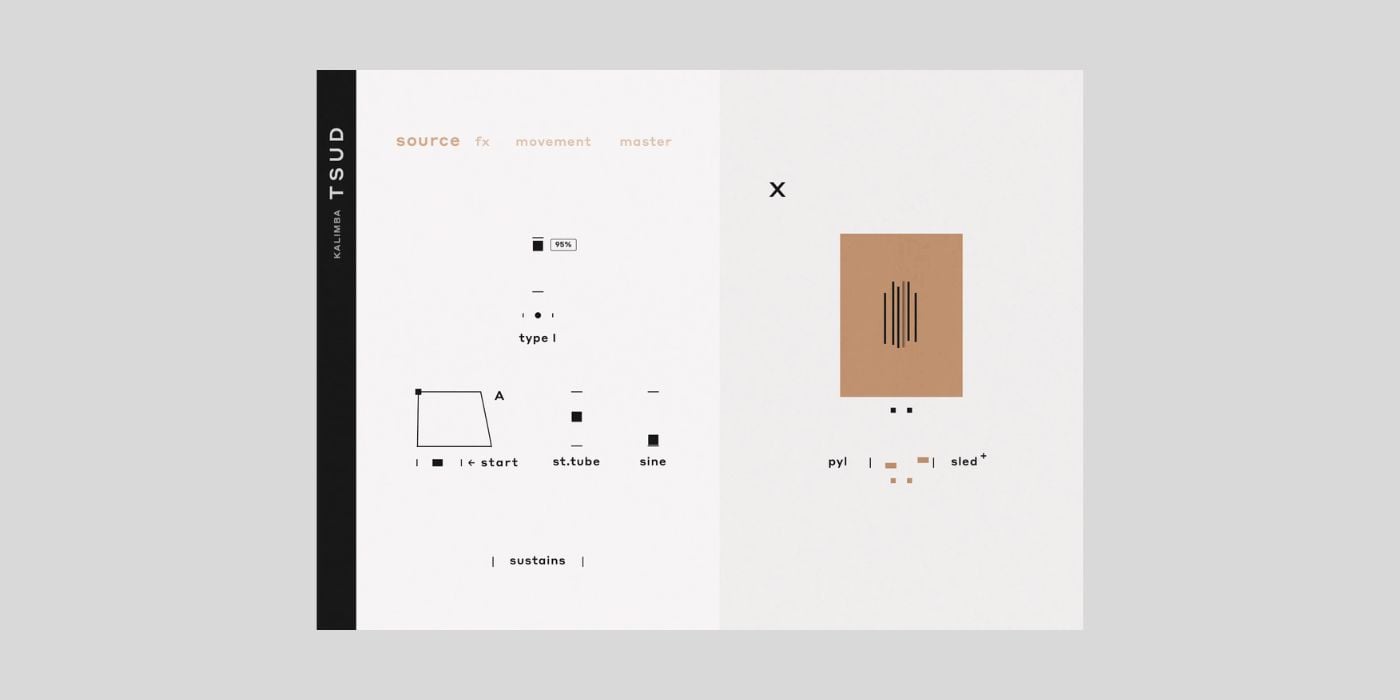
The interface is awesome, too. It’s abstract but still easy to understand. I’m a visual person, and I find that a well-designed interface adds to the overall experience of using an instrument. This one is pretty cool.
Under the hood, TSUD offers two main sound types.
Type I is the pure recorded sound with every imperfection intact, including fingers brushing the tines. Type II sends the same signal through filters and tube preamps, transforming the kalimba so that it sounds close to a muted electric piano.
The X-slider crossfades between the raw kalimba and four additional sound layers built from the original signal, stretched and softened into something weightless. Two extra sliders add a Soviet synthesizer sine wave tuned one octave below for weight and a tube-saturated version run through a cassette recorder for grit.
And if you like cassette tape grit, check out our free BPB Cassette 808 sample pack.
The FX section includes vibrato, a warm distortion effect, shimmer reverb with pitch shifting, and chorus, echo, and reverb. There’s also a 12-step sequencer and two LFO modules for adding movement to the sound layers.
The master panel features vintage octave filters, a three-band shelving EQ, and pitch and noise controls.
The sampling goes deep with up to four velocity layers per note and five round robins. That’s part of the reason why TSUD weighs in at 2.4 GB uncompressed, which is a lot for a kalimba. But if you appreciate detailed sampling, that file size is the trade-off for the quality you’re getting.
For me, this is a definite keeper.
TSUD is available in VST3 and AU formats for macOS (10.11 and higher) and Windows. It is not compatible with Pro Tools or other DAWs that don’t support VST3/AU.
Download: TSUD by Elementary Sounds (FREE)
Deal of the day 🔥: Get the VATRA mix finisher plugin by Flame Sound!More:
- Universal Audio launches UAD Explore FREE plugin bundle with 8 plugins and the LUNA DAW
- Fracture Sounds releases Blueprint: Thumb Piano, a FREE characterful kalimba for Kontakt Player
Last Updated on April 15, 2026 by Tomislav Zlatic.
