



Mikey Audio has released Shu, a free reverb plugin for macOS, Windows, and Linux.
Shu offers seven different reverb algorithms in a single interface. The seven modes are Silk (a smooth and clean reverb), Drift (spacious with a bit of modulation), Plate (classic studio plate), Classic (bright), Slap (tight room), Spring (spring tank), and Ether (a pitch-shifted shimmer).
Mode switching is crossfaded so you can audition algorithms mid-playback without clicks.
I like this kind of workflow in a reverb plugin because I usually don’t want to adjust many parameters. I’d much rather let the algorithm do most of the work and just tweak the main controls like decay time, damping, and a bit of tone shaping to fit the source.
Shu is built around that approach, so it’s a good fit for me in that sense.

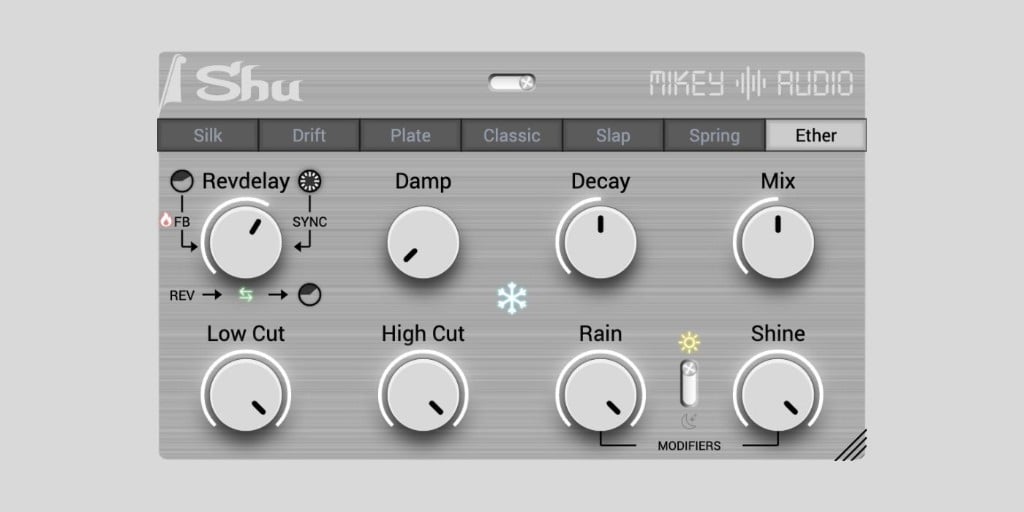
The five main knobs that stay visible across all modes are Mix, Decay, Damp, Low Cut, and High Cut.
Damp gradually shaves highs off the tail as it decays. Low Cut and High Cut are wet-only filters for keeping the reverb out of the way of the dry signal, and Decay sets the tail length.
Two extra knobs in the bottom row change their function depending on the selected algorithm. For example, you get Mod Depth and Rate for Silk and Drift, Diffusion and Size for Plate and Slap, Dispersion and Brightness for Spring, Rain and Shine for Ether, and so on.
My favorites here are Spring and Ether.
The Spring isn’t a particularly realistic emulation of an actual spring tank, but it sounds fine on its own terms and has an interesting character. I like adding something like this to synths and drums as a very subtle layer for a more organic feel.
Ether’s pitch-shifted shimmer is also pretty fun to play with on sustained material.
There are a couple more cool features worth mentioning. The predelay can be tempo-synced and has its own feedback and saturation controls (so it can double as a delay before the reverb).
There’s also a parallel reverse-delay path with the same FB and SAT controls plus a Blend knob. So basically, if you set Mix to 0% and turn Blend up, you can use it as a standalone reverse-delay effect.
If you’re wondering what the snowflake-shaped Freeze button in the center does, it pins the current tail to near-infinite sustain, and you can let it ring out naturally when you bypass the plugin.
I think Shu is worth a try if you like having multiple reverb characters in one plugin. It’s not a must-have if your reverb shelf is already well stocked, but it’s a fun one to try and possibly keep.
Shu is available in VST3, AU, and CLAP formats for macOS 11.5+ (Intel and Apple Silicon), Windows 10+ (64-bit, VST3 and CLAP), and Linux (x86_64, VST3 and CLAP). Donations are welcome but not required.
Download: Shu (FREE)
Deal of the day 🔥: Get the VATRA mix finisher plugin by Flame Sound!More:
