



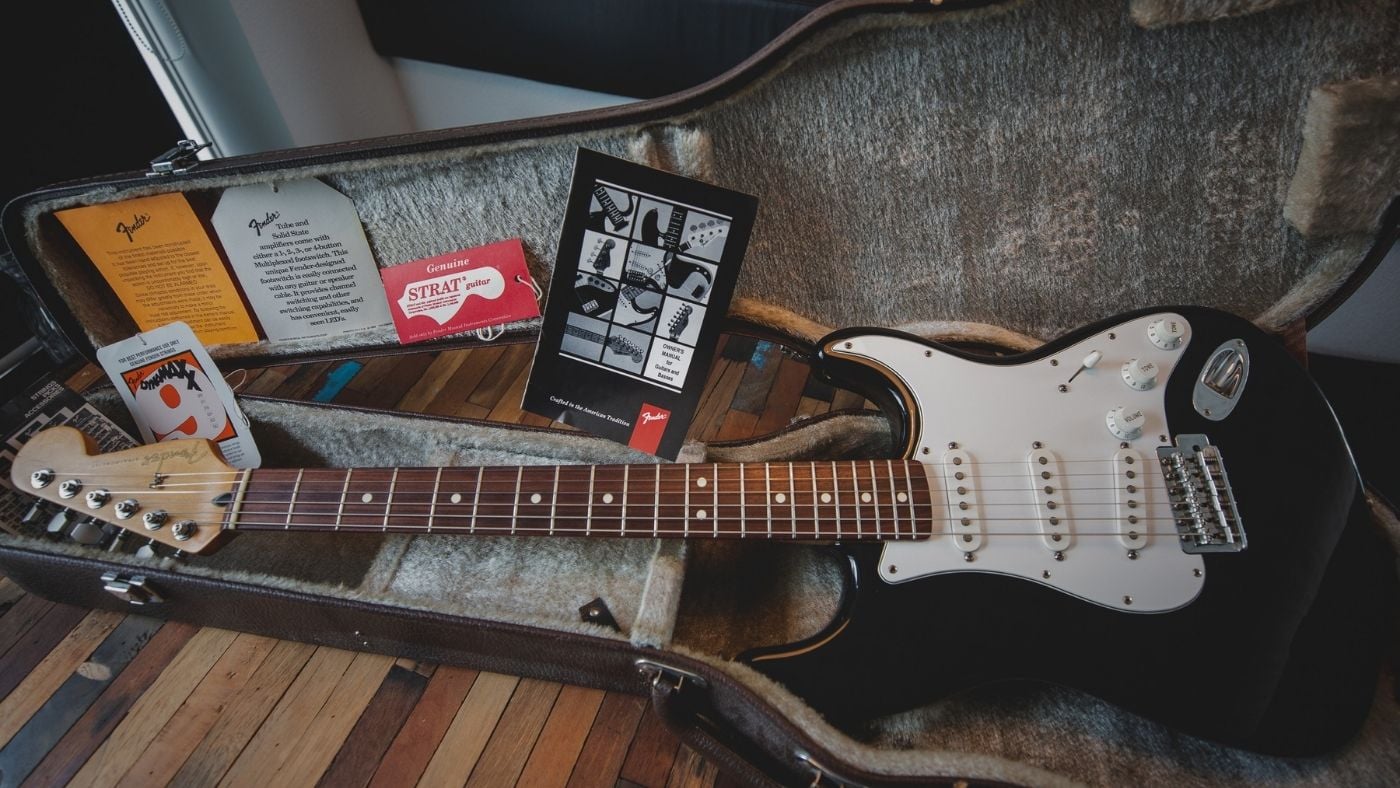
Fender, one of the most recognisable brand names in the world, is to the guitar what Steinway is to the piano – it is the name that comes to mind first, even for people who have never played an instrument in their lives.
That kind of brand identity and trust takes a lifetime to build, if you’re lucky; most brands never get there.
Unfortunately, almost all current discussions about Fender focus on what many consider to be overreaching and unnecessarily aggressive legal action surrounding the copyright of the Stratocaster (S-Style) body design.

With these latest legal proceedings, the iconic manufacturer, founded by Leo Fender way back in 1946, may be about to find out that almost anything that takes a lifetime to build can be torn down in moments.
Here’s a brief timeline of recent events before we get into more detail.
- Fender secured a landmark copyright ruling on December 22, 2025.
- The copyright ruling became widely known in March of 2026.
- Fender sends cease-and-desist letters to various manufacturers.
- Fender seems to backtrack slightly on its demands.
Fender secures landmark copyright ruling.
On December 22, 2025, Fender secured what Bird & Bird law firm is calling a landmark copyright ruling at the Regional Court of Düsseldorf (Germany).
It wasn’t till March of 2026 that the ruling was widely publicised, and met with intense backlash.
The ruling protects the Fender Stratocaster (S-Style) body design, first introduced in 1956, as a “copyrighted work of applied art” under German and EU copyright law.
This protection means it is now illegal to sell or distribute infringing products anywhere in the European Union, regardless of where they are manufactured.
The outcome of the hearing in Düsseldorf is what you’d call a default ruling because it was uncontested (Yiwu Philharmonic Musical Instruments Co, the manufacturer targeted in the original judgment, did not attend). The term uncontested may become very important as this story progresses.
What this ruling means for the industry
Well, it has the potential to be catastrophic for retailers and manufacturers of all sizes, including Fender.
The S-Style body shape is ubiquitous across the guitar world, and many guitarists are more attached to the design than to any particular manufacturer.
Retailers can no longer import non-Fender S-Style guitars for the EU market, which could lead to significant, if not devastating, revenue losses.
Similarly, manufacturers can no longer produce S-Style guitars for the EU market, and for some boutique builders, it could mean closing the doors.
Future infringements could incur a fine of up to $250,000 per infringement.
Although the ruling only applies to the EU market, it will also hurt the pockets of manufacturers and distributors who export to that region.
Here are just a handful of the manufacturers who use strat-like designs:
- PRS
- Suhr
- Ibanez
- Charvel
- Jackson
In addition to those familiar names, countless smaller brands utilise the S-Style design.
Cease-and-Desist
After securing the copyright ruling, Fender began sending cease-and-desist letters to manufacturers, including Yiwu Philharmonic Musical Instruments Co, LsL Instruments, and PRS.
Here’s where it gets messier.
Whether you agree or disagree with Fender’s right to protect its iconic design, it’s easy to understand why some people call the company’s initial demands little more than corporate bullying.
In the earliest letters, Fender demanded:
- An immediate stop to the making, marketing, and selling of infringing products.
- The destruction of existing stock.
- Recall of distributed stock.
- Handover of historic sales data.
- Compensation for legal fees.
Misunderstandings
As expected, the initial demands, which Fender had to know would cripple some manufacturers, didn’t go down well with the guitar community.
Fender claims that many elements of its actions that the public widely regards as unreasonable and overreaching are simple misunderstandings.
In response, Fender has clarified that the ruling will only target clones and close copies of the Fender Stratocaster and is NOT seeking to prevent others from manufacturing all double-cutaway bodies.
How close is too close?
Now, we have this grey area because PRS has confirmed it received a cease-and-desist letter from Fender, but disagrees with the complaint entirely.
No one can deny that the PRS Silver Sky (endorsed by John Mayer) is heavily inspired by the Fender Stratocaster; you see it, and you think Strat.
But it’s not exactly the same; there are differences in contour and design elements.
So what’s the cutoff point for Fender?
The cutoff point may correlate with the term “uncontested” that I said would become important as events play out.
Uncontested
Default rulings, although legally binding, don’t always stand up to a strong challenge.
It seems a fair assumption that Fender is perhaps acting so aggressively (albeit while backtracking slightly to save face) in an attempt to strike while the iron is hot.
Some corporate legal experts will argue that anyone with the financial means to be heard may stand a reasonable chance of contesting the ruling.
In 2009, Fender unsuccessfully attempted to trademark the Stratocaster, Telecaster, and P-Bass body shapes in the US amid fierce challenges from other builders.
In that case, the court ruled that the designs were so widely used for so long that they were effectively in the public domain.
Whatever the final outcome, I imagine there are a few twists in this story yet.
Timing is everything
I’m not against any individual or group protecting creative work, and I consider the S-Style body to be a creative work.
It’s far more than just a functional design.
My problem is that people have been using this design freely since the 1970s or so.
If this new ruling were made months after the first “Superstrat” appeared, the public response wouldn’t be nearly as severe.
At this point, it feels similar to relatives of Mildred and Patty Hill demanding a slice of the cake every time anyone sings Happy Birthday.
The ship has sailed, and shouldn’t be called back now.
The court of public opinion
I’ve heard people say that it’s the legal decisions that matter most in this case, and I strongly disagree.
Fender could easily be the biggest loser here; you can have all the protection you want, but it’s worthless if no one buys your product.
By taking legal action, Fender isn’t just restricting the competition; it’s restricting the musicians.
Rather than trying to tempt guitarists to choose the original Stratocaster by focusing on making the best instruments, Fender is effectively trying to take other guitars out of people’s hands.
Removing someone’s choice and providing a better option are polar opposites.
Sentiment is important in all consumer industries, but especially so in music, where the instrument is an extension of the musician.
It’s not like using a MacBook while complaining about Apple’s many flaws as a company.
There’s an emotional attachment to an instrument because it’s part of your sound, it’s not just utilitarian.
Fender’s chosen path will almost certainly alienate more new and existing customers.
Fender has a history of underappreciating customers (much like Apple); in 2020, Fender Europe was fined around £4.5m for engaging in Resale Price Maintenance. The company forced retailers to maintain a minimum price, dictating the value individual sellers could offer customers.
A new CEO
I just want to touch on this briefly; Rick Beato mentioned in his video that Fender’s current CEO, Edward “Bud” Cole, had only been in position for a few months.
My immediate thought was that it’s not uncommon for companies to appoint a new CEO right before making a controversial move. If such a move backfires, it’s also not uncommon for a company to point fingers at the recently appointed, and now departing, CEO and their poor decisions, while apologising and promising to do better in the future.
Cynical minds might assume that sort of CEO might be a patsy brought in to take the heat, along with a handsome payout, should things go sideways.
However, Edward Cole has been with Fender for over a decade, serving as President of the Asia-Pacific region and as a significant part of Fender’s leadership.
To be continued
It would be easy to say I expect Fender to backtrack further, almost into full reversal, as the community backlash mounts, but you can’t count on a company that doesn’t learn from past mistakes.
There’s one piece of advice that’s almost universally applicable, and it comes from Kenny Rogers.
“You’ve got to know when to hold ’em, know when to fold’ em.”
By all means, stop everyone from branding a non-Fender guitar with the name Stratocaster, but Fender has massively overplayed its hand here.
And I thought we were done with corporate shenanigans after the Native Instruments fiasco.
Read more: Fender
Last Updated on June 4, 2026 by Tomislav Zlatic.
