


Every few weeks, someone asks me some version of the same question. Should I learn Vital or Surge XT?
It’s a tough question because these are the two best free synths you can download in 2026, and either one can realistically be called the greatest free synth of all time.
So I decided to test them head-to-head once again and came to a similar conclusion. It’s very hard to choose between these two.
Vital and Surge XT are built around two different ideas of what a synth should be. The right pick has less to do with specs and more to do with which idea matches the way you like to work.
So instead of a feature-by-feature scorecard, this is how I’d actually choose between them.
And why you’ll still probably end up with both anyway.
Two different ideas of what a free synth should be
One is focused and polished, the other is broad and deep
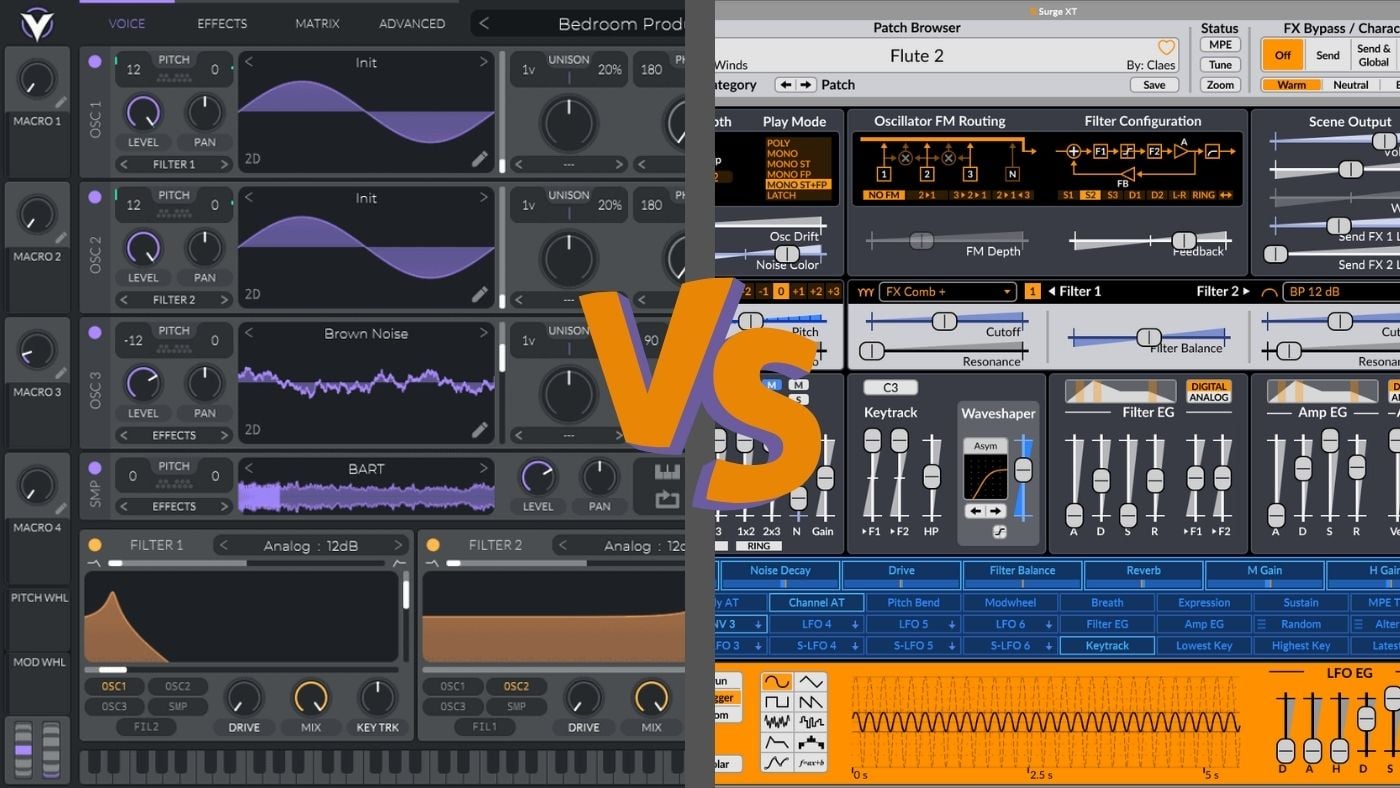
Vital is Matt Tytel’s spectral wavetable synth. It has three wavetable oscillators, a sampler oscillator, two filters, a drag-and-drop modulation system, and an interface that shows everything you do.
Vital offers speed, clarity, and polish. You see what the synth is doing at all times, and you get to a finished sound relatively fast (depending on the sound, of course).
Surge XT comes from the other direction. It started life as a commercial synth by Vember Audio, went open source, and is now maintained by the Surge Synth Team.
Surge XT offers everything. It crams wavetable, virtual analog, FM, string modeling, and a pile of stranger engines into one instrument, with more than 2,700 factory presets on top.
Both run on Windows, macOS, and Linux. Both are free. Both are amazing. So, which one’s better?
Vital gets you to a finished sound faster
The visual workflow is still the best teacher around

Vital is Matt Tytel’s spectral wavetable synth, and the free version is still ridiculously good in 2026.
You get three wavetable oscillators, a sampler/noise oscillator, two filters, envelopes, LFOs, random modulation sources, a proper effects section, and, in my opinion, the best interfaces ever put on a free synth.
That last part matters a lot when learning synthesis.
Vital shows you what is happening. Drag an LFO to filter cutoff, and you can see the movement. Or, modulate the wavetable position, and the interface animates it in front of you.
For anyone learning synthesis, that visual feedback is invaluable.
This is why I still think Vital is the better first synth for beginners.
You can make a bass, pad, pluck, lead, or weird evolving texture without feeling like you’re operating a spaceship. The main page gives you the important stuff, the effects page is intuitive, and the deeper features are there if you want them.
Vital is also the more modern-sounding synth of the two, especially for electronic music. The spectral warping tools bend the harmonics inside a wavetable rather than just filtering it, which is where those contemporary EDM, bass music, trap, and hyperpop textures come from.
The wavetable editor is also excellent. You can build and shape tables in a way that feels more intuitive than most free synths, and the text-to-wavetable feature is simply amazing.
The free version gives you the full engine with 75 presets and 25 wavetables. The paid tiers ($25 and $80) mostly add more content, and there are hundreds of free third-party preset packs out there, so you won’t run out of sounds.
Not everything is ideal, though.
Vital’s interface can make CPU meters look more dramatic than the actual load (I’ve found that closing the plugin window helps on weaker machines). And its update pace has slowed down a bit lately, though it’s still alive and maintained, with newer builds appearing in early access in 2026.
Surge XT does more than any free synth has a right to
Mo modulation Mo presets
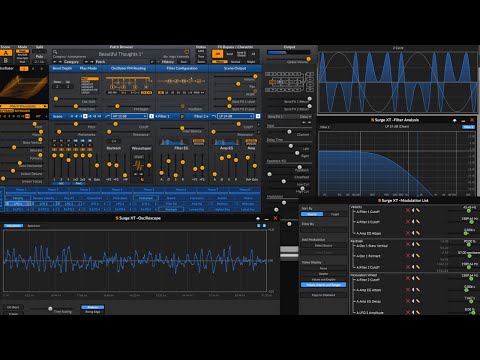
Surge XT is probably the deepest free synth ever made.
Each patch has two scenes, which means two complete synth layers you can stack or split across the keyboard. Each scene gives you three oscillators with twelve algorithms to pick from.
There are two FM engines, a String oscillator for physical-modeling plucks and bows, an Alias oscillator for nasty lo-fi digital tones, and Twist, which is based on the Mutable Instruments Plaits Eurorack oscillator. You can even route external audio through the engine.
Then there’s the preset situation. Surge XT ships with over 2,700 factory patches, which is honestly an absurd number for a free instrument.
The modulation system goes deeper than Vital’s too, with drawable multi-segment envelopes, a step sequencer, and a Formula modulator you can script in Lua if you’re into that kind of stuff. The effects section runs to 27 algorithms across 16 slots, and there’s even a separate free Surge FX plugin that gives you the whole rack on any audio track.
It’s also the synth I’d pick for MPE and microtuning. Support for both runs deep (it’s effectively the house synth for Roger Linn’s LinnStrument), and it can even load Serum-format wavetables.
And because it’s a healthy open-source project with a team behind it, new features and fixes keep landing all the time.
So where’s the catch? Well, it’s right in front of your nose.
Surge XT is packed, both in terms of specs and visually. Also, it doesn’t show you modulation the way Vital does. And it can look impossible to learn at first.
The common story I hear from BPB readers (and see on forums) goes the same way. People bounce off it the first time, come back later, and end up keeping it forever.
On the plus side, it’s surprisingly lightweight. If you stack instances in a big session, Surge XT is the better-behaved of the two.
Which one should you install first?
Match the synth to how you work, not the other way around
If you’re new to synthesis, get Vital first. It shows you what modulation does, and I already picked it as the one synth worth learning deeply in my list of free plugins for beginners.
If you make modern electronic music, Vital again. The spectral wavetable engine is built for exactly those sounds.
If you want a huge library of ready-to-play sounds without spending anything, Surge XT. No free synth comes close on presets.
If you already know your way around a synth and want FM, physical modeling, microtuning, MPE, or just more territory to explore, I’d also pick Surge XT. It rewards digging like nothing else in the freeware world.
And if your computer is older or your sessions are heavy, Surge XT tends to be the lighter choice in practice.
The honest answer is both
They cover different ground, and they’re free
I know “install both” is the easy answer, but in this case, I think it’s the only one that makes sense.
Vital and Surge XT don’t really compete. One is the fast, visual, modern wavetable synth. The other is the deep, sprawling everything-synth.
I reach for Vital when I have a specific sound in my head and want to get there quickly. On the other hand, I load Surge XT when I want to browse, experiment, and stumble into something new.
If someone forced me to recommend just one, I’d ask them one question first. Are you learning, or are you exploring?
If I were starting music production today and wanted one free synth to learn deeply, I’d probably start with Vital because it teaches synthesis so well.
If I already knew synthesis and wanted the most powerful free synth I could install, I’d pick Surge XT.
But again, nobody is forcing you. Two of the best synths of 2026 are free, and they get along just fine in the same plugin folder.
Last Updated on June 10, 2026 by Tomislav Zlatic.
