


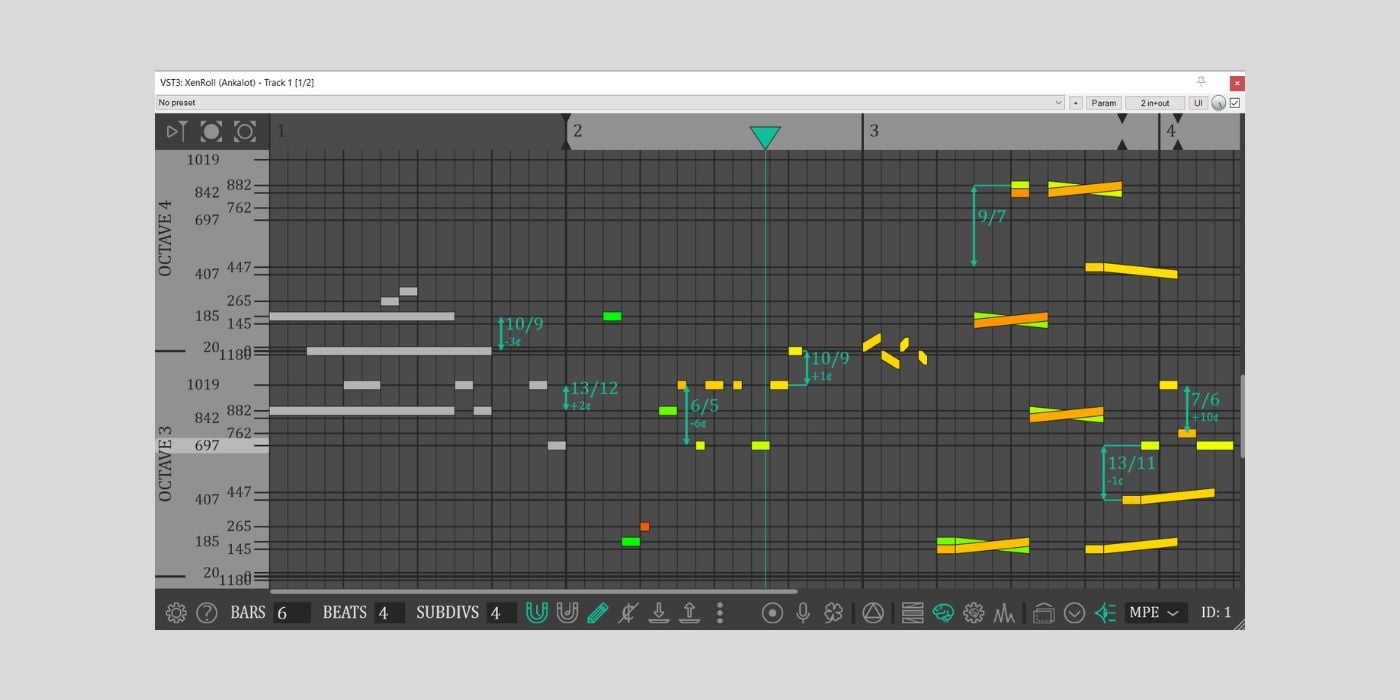
Developer Ankalot has released the 0.4.3 version of Xenroll, a free and open-source microtonal piano roll for macOS, Windows, and Linux.
Xenroll is a free and open-source piano roll plugin that allows you to define pitch with an accuracy of one cent.
There are 100 cents in a semitone, which means you have 1200 cents per octave, and Xenroll opens up all of that space between the notes.
The plugin is available in VST3 format for macOS, Windows, and Linux. Xenroll is currently in version 0.4.3, so updates and improvements will likely be fairly frequent, but it’s worth checking out if you’re interested in exploring microtonality.
Before downloading Xenroll, you should read through the “how-to” details and requirements on the project page. The developer has also included a list of known compatible synths/samplers, including Surge XT, Serum, Serum 2, Pianoteq, Vital, and u-he Diva.
Here are some of the core features:
- Define pitch with an accuracy of one cent
- 1200 cents per octave
- Bend notes individually in a visible way
- Generate notes/pitch curve in real-time by humming or singing
- Short-term memory model
- dissonance submodels
- Import/Export tracks
- Uses MPE or MTS-ESP for microtuning
Discussions about microtonal music and equal temperament versus just intonation can be fairly divisive, but it’s not new, even in Western music.
Early 20th-century adopters like Harry Partch, with his custom-built instruments and 43-tone scale, led the Western vanguard a long time ago. More recently, popular artists like Jacob Collier often talk about the benefits of retuning major/minor thirds, etc., according to the natural harmonic series.
The problem with topics like microtonal music is that some musicians can use it as a vehicle to be different just for the sake of being different. We can say the same about topics like negative harmony.
I can understand why many people push back against these things, because there are still musicians who actively aim to make their work esoteric by misusing or overusing otherwise interesting practices.
Unnecessary complexity is rarely a recipe for success, nor an impressive sign of musical understanding in any way that matters.
But it’s not something to ignore; whether you’re taking a deep dive into microtuning or just looking for microtonal moments, it’s worth exploring.
Microtonal moments can make a huge (and often uncredited) difference in all kinds of music.
It could be Chuck Berghofer’s iconic fretless upright bass glide, rather than definitive semitones, on These Boots Were Made for Walkin or the use of microtuning to create tension and dissonance.
Many of the best movie scores use microtuning in places to create a stronger feeling of unrest, and it works perfectly.
Another way to create a strong feeling of unrest is to tell you that there’s only one day left to enter our exclusive Bjango giveaway (Robot Rocket and Chaos Line). We will announce the winners on June 17, 2026, so if you haven’t entered yet, do it now; good luck!
Download: XenRoll (FREE)
More:
- ANWIDA Soft’s Stereoid Light stereo enhancer is FREE for a limited time
- W.A. Production offers the Vocal Splitter plugin for FREE for a limited time
Last Updated on June 17, 2026 by Tomislav Zlatic.
