


Jeff McClintock has released SynthEdit 1.6, a major update to the modular plugin development environment.
The big headline here is that SynthEdit now finally runs natively on macOS. After decades as a Windows-first tool, it can now export 64-bit VST3 plugins for Windows and macOS, plus Audio Unit plugins for macOS.
When I started making music, SynthEdit and SynthMaker plugins had a strange reputation. They made plugin building possible without writing C++ from scratch, but many musicians treated them as lesser plugins compared to hand-coded tools.
To be fair, that reputation wasn’t completely random. Some SynthEdit and SynthMaker plugins were generic bread-and-butter effects with a fancy GUI, and some were not very well optimized because they leaned heavily on stock modules.
But that reputation also became unfair because plenty of great plugins were made with those tools.
This is why I recently wrote that vibe-coded plugins are giving me SynthEdit deja vu. The annoying part of the current AI plugin wave is not simply that AI is involved.
What I have a problem with is the zero-effort vibe-coded plugin with almost no thought behind it, pushed out as a finished product and sometimes even sold commercially. You wouldn’t believe some of the “releases” that reach the BPB inbox nowadays.
Seeing SynthEdit updated now gives me a bit of nostalgia for those old days. I am happy to see the platform still alive, and I hope this new version inspires some interesting projects in this era when quick plugin-making tools are everywhere again.
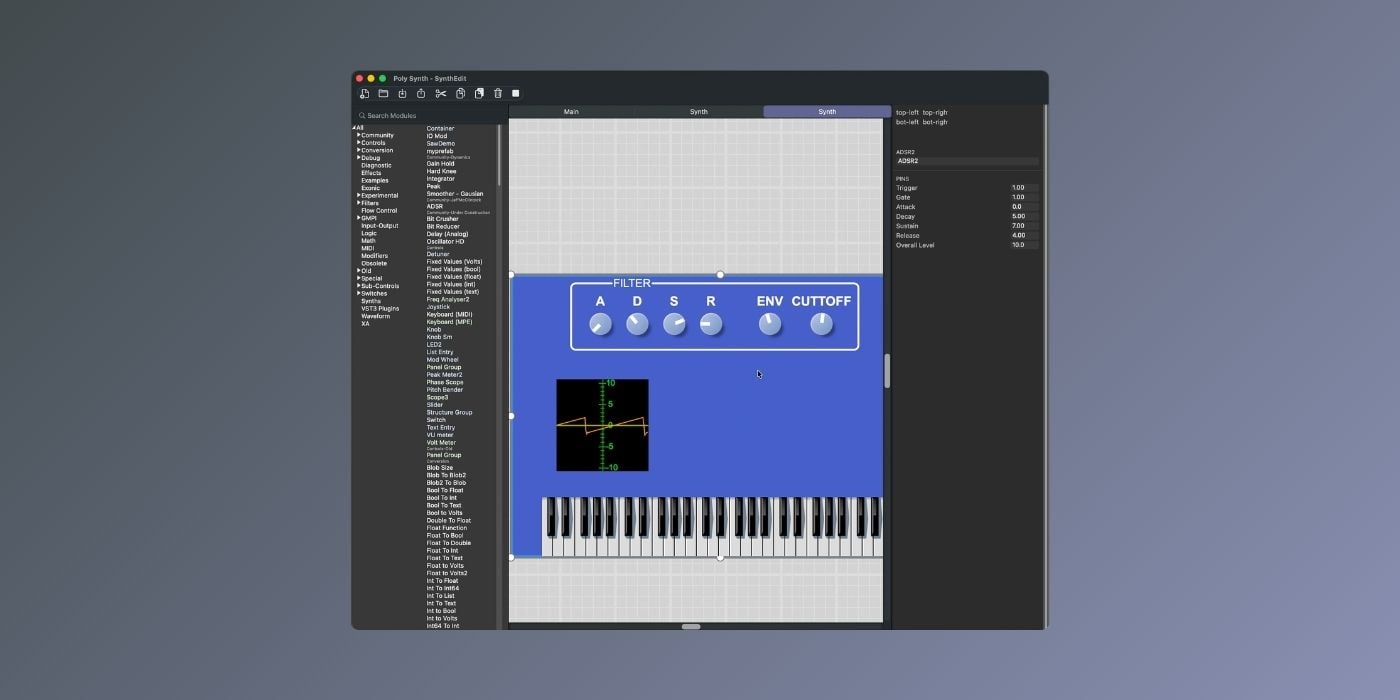
SynthEdit is a modular environment for building synthesizers and effects. You patch oscillators, filters, envelopes, arithmetic modules, and other building blocks on a canvas, design the plugin front panel, and export the finished result without paying royalties to SynthEdit.
The new website is direct about what the platform is and is not. Visual patching can take you far, with 300+ built-in modules, 32-bit floating-point DSP at any sample rate, up to 128 voices per instrument, live signal scopes on pins and wires, a drag-and-drop panel designer, and plugin export included in the normal workflow.
If you want to go deeper, there is an open SDK for writing DSP in C++, community modules, and SE2JUCE export for moving a project into JUCE-compatible source code. McClintock is clear that this is real software development, not a magic checkbox, but it does mean SynthEdit projects are not locked inside one file format forever.
Version 1.6 also brings an experimental Linux preview. The Linux editor needs a Wayland session, while exported plugins carry both X11 and Wayland paths in one binary, so they can run in hosts such as Ardour. The Linux build is free while in preview.
There are still limits. Standalone application export is not supported yet, CLAP support is not ready, and MIDI-effect-style plugins remain awkward because of VST3 MIDI limitations.
SynthEdit 1.6 is available for Windows and macOS, with the Linux build offered as an experimental preview. The demo is fully featured for 60 days, including plugin export, and a full license costs €170 as a one-time purchase.
Download: SynthEdit 1.6 (€170, 60-day demo available)
Deal of the day 🔥: Get the VATRA mix finisher plugin by Flame Sound!More:
Last Updated on August 8, 2026 by Tomislav Zlatic.
