


JAS-I Khorlo, a free physical modeling/resonator synth for macOS, Windows, and Linux, is now in open beta.
When we post news about new releases, we occasionally run into a few problems.
For example, sometimes installers won’t download, or emails take a while, and that’s not ideal if you’re against the clock.
On rarer occasions, a new instrument is so instantly addictive that you need a reminder to put it down and write something (also not ideal when you’re against the clock, but a much more enjoyable problem to have).
Khorlo has provided one of those rarer occasions, and for a synth in open beta, it’s feature-packed and drama-free so far.
Khorlo takes the basics of a physical modelling synth, where an exciter strikes/activates a resonator, and adds a twist that takes us into a polyrhythmic wonderland.
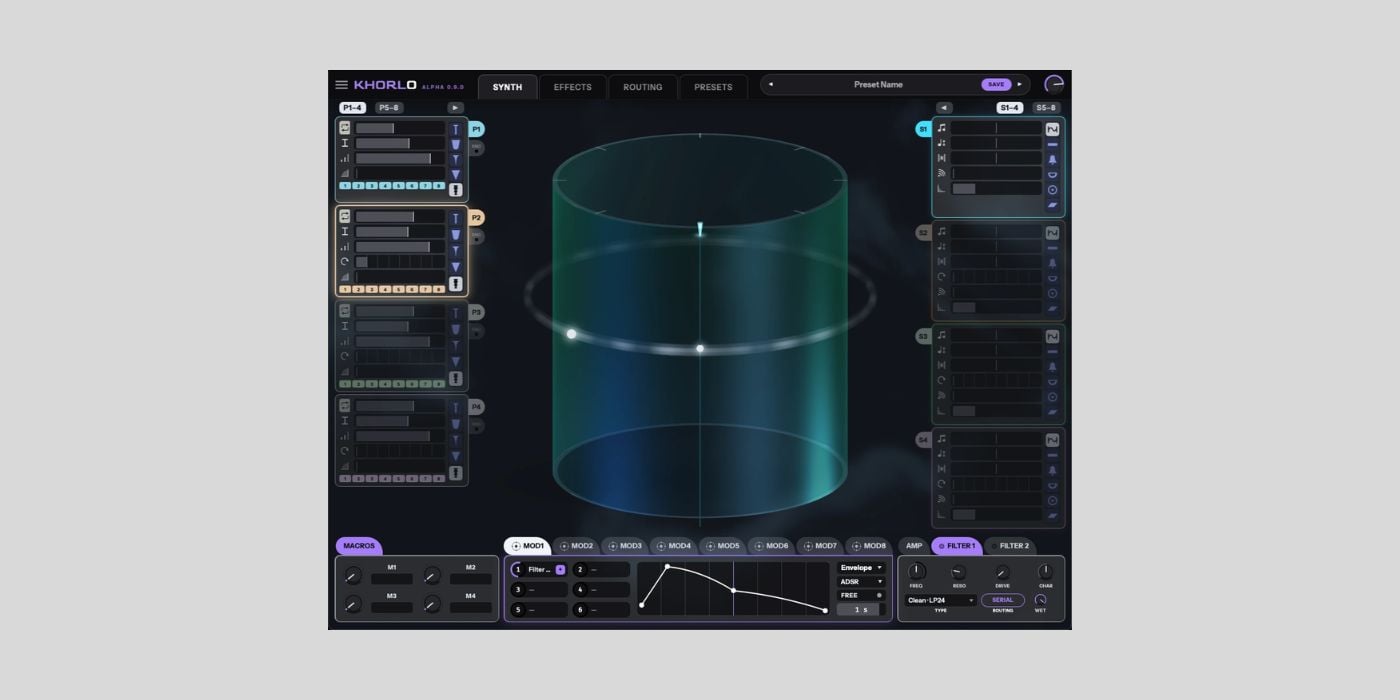
The twist is a cylinder that forms the foundation of how the exciters and resonators interact.
Pluckers are rings on the cylinder that exciters travel around as you hold a key/note. Strings are resonators positioned around the cylinder.
Each time an exciter passes a String in its cycle, it triggers its sound.
You can change the type of exciter used per Plucker to alter the type of pluck or impact triggering the resonator.
Similarly, although called Strings, each String can be a Beam, Bell, Bowl, Membrane, Plate, or, well, a String.
That’s the most basic description of Khorlo, and the lovely interface shows everything in motion. The GUI is also very well designed: the Pluckers on the left and Strings on the right are almost mirror images of each other.
Once you start making noise, Khorlo becomes all about variation, and the variation is virtually limitless.
It starts with per-Plucker parameters that adjust where and how the exciter strikes the string. Height is an important parameter: high is bright and low is dull. You then have extended parameters that let you adjust the size and form of your chosen exciter.
One of my favourite elements here is that you can control which Strings each Plucker interacts with, and which Strings they bypass. When you have a few or more acting Pluckers and multiple Strings in play, you can start to see the polyrhythmic potential here.
Moving across to the Strings, you have parameters like Pitch, Pan, and Decay per String. You also have extended controls to alter the string stiffness, treble, saturation, etc.
Just by using the Plucker, exciter, and String options, coupled with the Rate (revolutions per second) and the number of notes you play, you already have everything from short percussive hits to sustained bowed sounds.
In other words, you’ve got short plucks for melodies or rhythmic patterns, bass sounds, plus sustained pads and leads.
Along the bottom of the GUI, you have eight assignable drag-and-drop modulators, four macro controls, an amp envelope, and dual multi-mode filters.
The modulation is pretty extensive, and very little is off-limits, from the Plauckers and Strings to the built-in FX and modulators themselves.
With modulation, you can take things from hectic to ridiculous, in a good way, and you’ve got a dedicated Routing page to keep on track.
I mentioned built-in FX, and you’ve got ten on a dedicated page, including compression, delay, chorus, flanger, saturation, phaser, and reverb.
You can do so much with the bare bones of this instrument, especially when you have elements synced to your DAW, synced to each other, and some running free.
But you can go deep on complex sound design, and it’s an absolute blast.
Additionally, Khorlo comes with over 130 presets, arranged in a nice browser with tags and favourites, etc.
Sky Burial and Cellar Bass are great!
Khorlo isn’t the only instrument taking a less traditional approach to physical modelling synthesis; if it’s your thing, check out PartialString by Different Instruments, too.
Khorlo is available in 64-bit AU, VST3, and CLAP formats for macOS (11 or later), Windows (10 or later), and Linux (needs WebKitGTK 4.1).
As an open beta, Kharlo is already impressive, and I’m sure it is only going to improve!
Download: JAS-I Khorlo (FREE – open beta)
Last Updated on September 3, 2026 by Tomislav Zlatic.
