


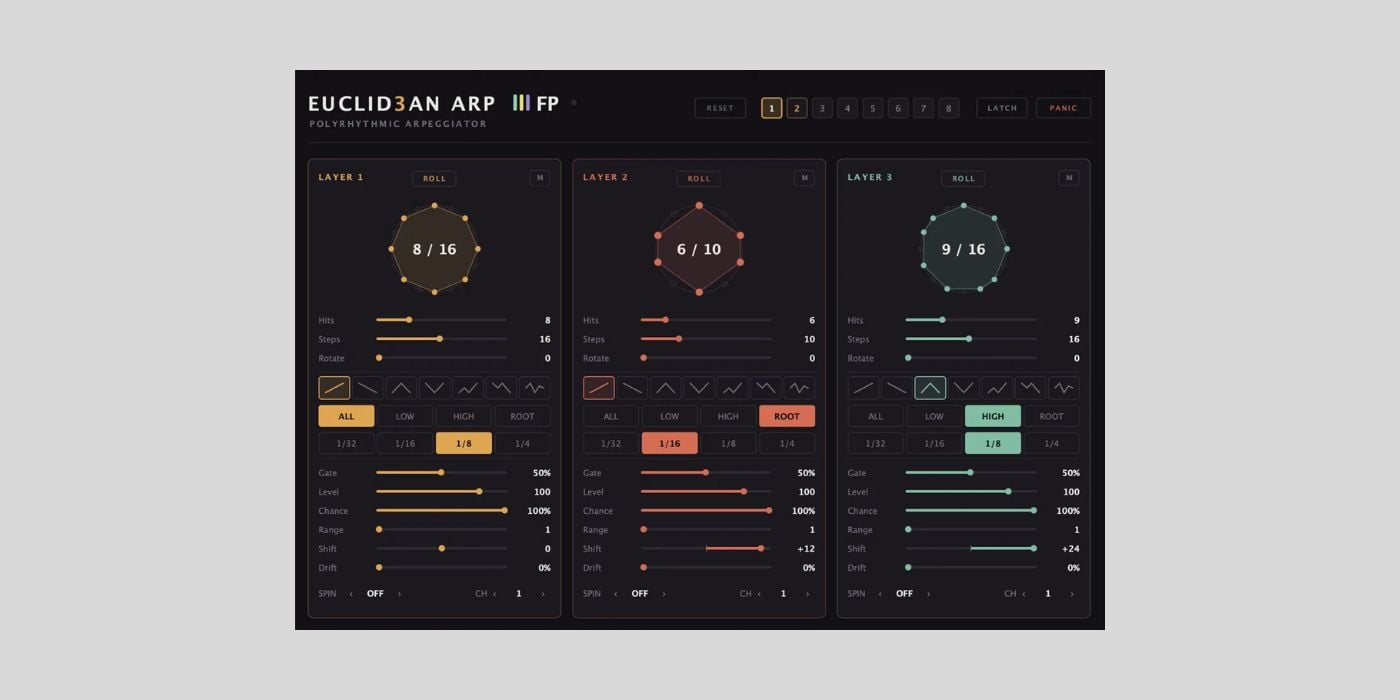
Developer François Pé has released the free Euclid3an Arp plus two chord/arrangement tools for macOS.
Euclidean algorithms come up fairly often in rhythmic audio tools, like Euclyd (multitap delay) by Artists in DSP, and the free Constellations Sequencer from Factor8.
Euclid3an Arp is the latest addition to this category, and you can now download this free polyrhythmic arpeggiator in AU/VST3 formats for macOS.
We don’t need to go all the way back to ancient Greece and Euclid’s findings to talk about groove, and we don’t need to get too bogged down in mathematics either.
In its most basic form, the idea of spreading a set number of hits as evenly as possible across a set number of steps/beats creates interesting divisions with the push-and-pull a great groove needs.
That is why Euclidean theories fit perfectly into so many world-music rhythms, like the Tresillo, commonly used in Cuban and African music.
Euclid3an Arp takes a slightly different approach to creating rhythmic patterns because you don’t have to program anything or rely on simply arpeggiating chord tones.
Instead, Euclid3an Arp focuses on selecting the number of hits and steps. This approach, in many ways, should lead to more experimentation and grooves that you might not typically program.
To make things more interesting, you have three layers, each with independent settings, creating complex polyrhythms. What I like best about the layer setup is that you can decide whether each layer uses all the notes of a chord, the lowest, the highest, or just the root.
I love the focus on the root because it gets lost easily in some pattern generators, and it’s so important to have that anchor, whether it’s solidifying a downbeat or pushing/pulling through displacement.
There are other ways to add variation to your groove, beyond the standard direction and note length settings, like the Spin feature, which advances rotation by one step at the end of each cycle.
Euclid3an Arp is the latest release from François Pé, but as I mentioned, the developer has released two chord/arrangement tools too, and I want to mention them briefly.
The first is Soooo Lazy, a chord/pattern generator that also features a three-layer Euclidean arpeggiator.
Soooo Lazy has five generators: Bass, Arp, Melody, Pad, and Pattern. These generators cover basslines, arp lines, melodies, sustained chord progressions, and rhythmic chord progressions.
It starts with the circle of fifths, and I like that it’s a great way to learn while creating. As always, it’s a thin line, and as long as you never become Toooo Lazy, you’re good!
Whichord is a chord generation generator with a much simpler GUI and fewer features than Soooo Lazy. I think its simplicity makes it a better learning assistant because it covers diatonic chords, modal interchange, and modulation clearly and concisely.
Both Soooo Lazy and Whichord are available for any price you feel is fair above £0.86.
A little help goes a long way toward helping future developments.
Download: Euclid3an Arp (FREE)
