


By Tomislav Zlatić, BPB founder, testing free plugins since 2009. Updated: . See how I test.
Valhalla Supermassive is the best free reverb plugin in 2026. Its 22 modes cover everything from short echoes to vast atmospheres and moving spaces, and the Warp knob makes it rewarding to shape by ear. It is the creative effect I would keep if I could keep only one.
If you want a natural-sounding room or hall, start with OrilRiver. If you want an expensive-sounding reverb as fast as possible, go for Magic7. If you want shimmer with almost no setup, try Sala.
The best free reverb VST plugins
- Best overall: Valhalla Supermassive
- Natural rooms and halls: OrilRiver
- Room, hall, and plate control: Dragonfly Reverb
- Expensive-sounding reverb, fast: Magic7
- Vintage digital color: OldSkoolVerb
- Huge 80s plate: TAL-Reverb-4
- Classic chamber: PSP Chamber
- Studio plate: UAD Pure Plate
- Spring and lo-fi grit: BPB Dirty Spring
- Rooms and halls on Windows: epicVerb mkII
- Sound design spaces: Native Instruments Raum
- Granular ambient textures: SOL
- Instant shimmer: Sala
- Seven reverbs in one: Shu
Supermassive by Valhalla DSP
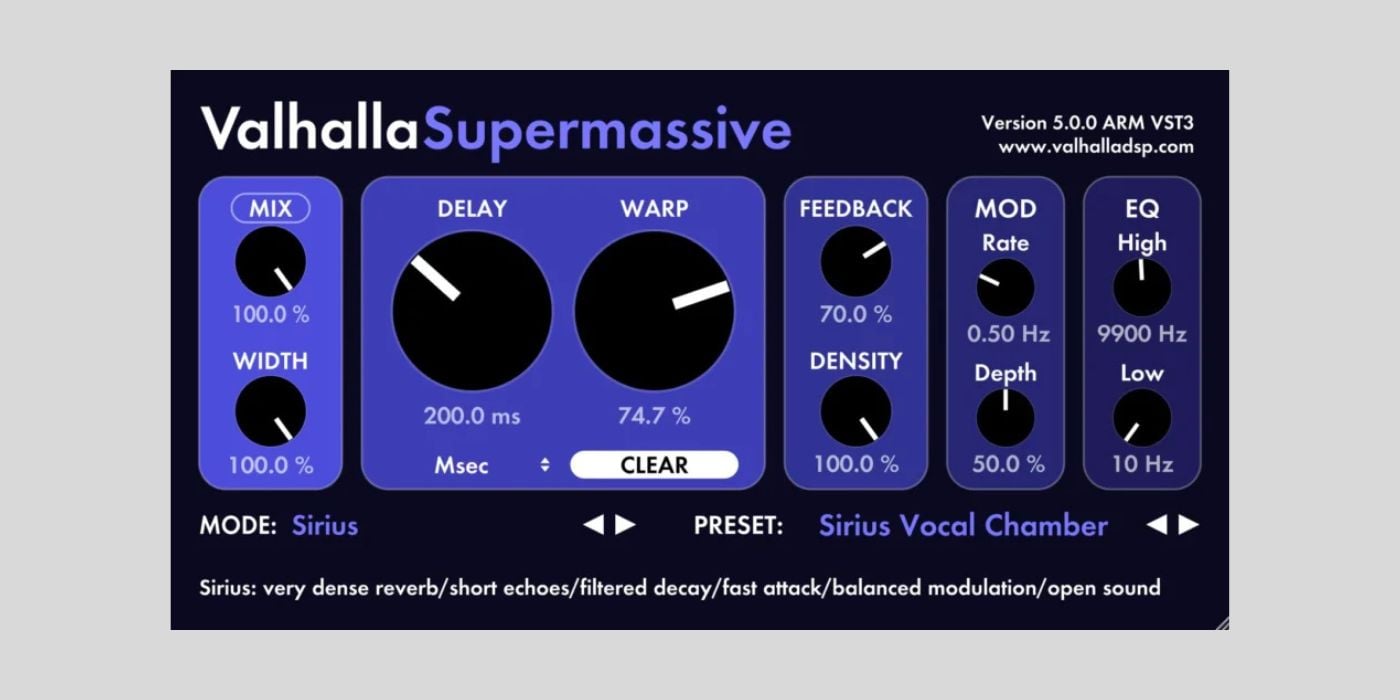
Supermassive is a reverb and a delay in one, built on feedback delay networks with delay lines up to two seconds long, so it covers everything from short echoes to lush reverbs with tails that decay over minutes.
The 22 modes are named after galaxies and constellations. Andromeda has the slowest attack and decays that can run into thousands of seconds, Cirrus Major and Cirrus Minor are cold 80s digital room sounds, and Libra is a lush all-rounder for synths and ethereal vocals.
Two of the newer modes handle natural spaces. Pleiades is the smoothest, most natural mode and can do realistic small rooms, and Sirius is a workhorse for rooms, halls, and cathedrals of any size. Still, for that natural sound on vocals or a drum kit, OrilRiver is more convenient.
Most of the modes are fantastic for sound design and can turn a short note into an evolving atmosphere. Supermassive suits everything from synths, guitars, and vocals to drones, ambient sound effects, and cinematic sound design, and it’s very light on the CPU for what it does.
My favorite control is Warp, which changes how the delay lines relate to each other, so one knob moves a patch from a clear echo to a complex reverb. I typically start by choosing a mode, then adjusting Warp and feedback. Once the shape is right, I add a bit of movement and fine-tune the EQ.
You can also click the Mix label to lock the wet level for sends, push the Width to a negative value to flip left and right, and set Feedback to 100% for an endless tail. There’s no dedicated pre-delay knob because the Delay control sets the network time instead.
What I don’t like is that the modes behave so differently that Supermassive can be harder to tame than a regular reverb. But you get used to it if you work with it long enough.
Valhalla built it in 2020 as a home for reverb algorithms too wild for its paid reverbs, and new modes arrive in a free update nearly every November. I named it BPB’s Best Free VST Effect of 2020.
Runs on: Windows, macOS (VST, VST3, AU, AAX)
What is free: everything; no account, license key, or authorization
Download: Valhalla Supermassive
OrilRiver by Denis Tihanov
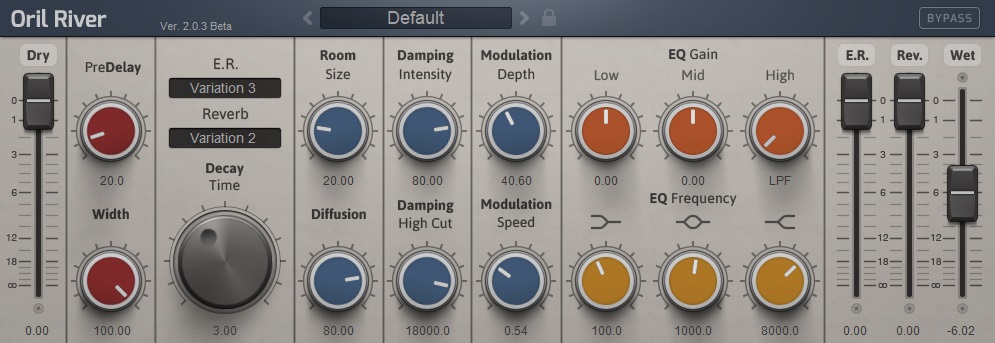
For a believable room or hall, OrilRiver is still my freeware pick. Most freeware reverbs, especially older ones, sound brittle or metallic to me, and OrilRiver is one of the few exceptions, with natural-sounding rooms and halls and a smooth tail.
Twelve early-reflection patterns and five tail variations give you plenty of reverb characters to choose from, alongside the usual size, decay, damping, and modulation controls. Values can be typed in, and the millisecond readouts make it easy to time the pre-delay and decay to the song. The 3-band EQ’s shelves cut all the way down, so they double as high-pass and low-pass filters.
There are two skins; I prefer the light one, but the dark mode is excellent for late-night mixing sessions. It’s light on the CPU on Windows, too.
Unfortunately, its development is suspended, and it hasn’t been updated in a while. The Mac version is Intel-only, so Apple Silicon Macs run it through Rosetta, which Apple is winding down after macOS 27.
Runs on: Windows, macOS (VST, VST3, AU)
What is free: the full plugin; no account or license
Download: OrilRiver
Dragonfly Reverb by Michael Willis
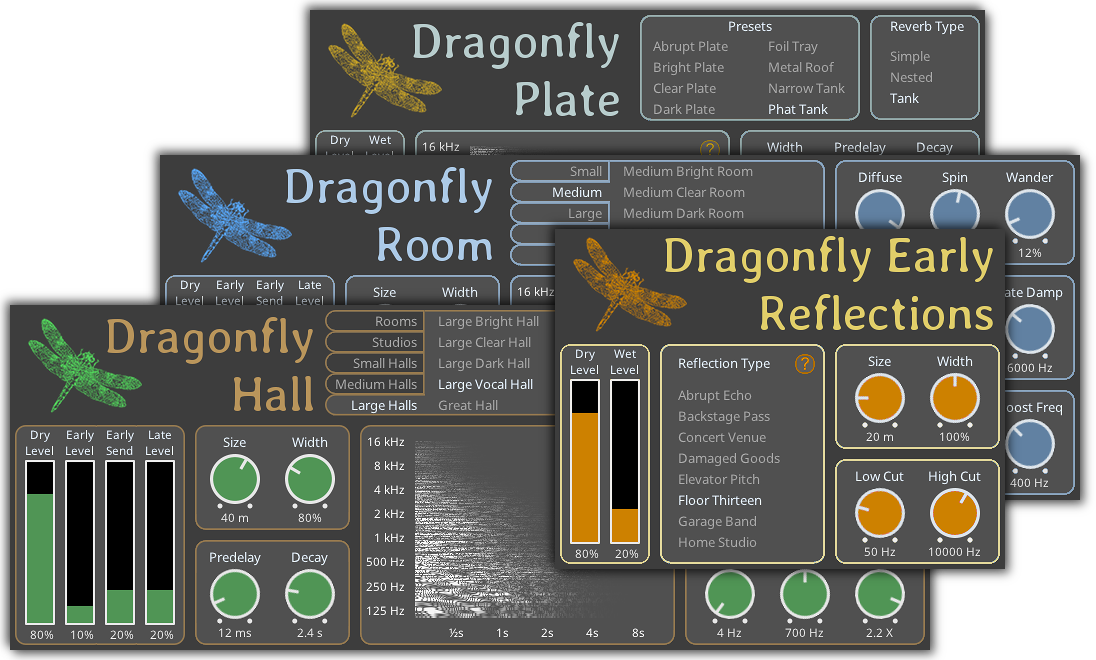
Dragonfly Reverb is not one plugin but four, each focused on a single job: Hall, Room, Plate, and Early Reflections. All four are open source and among the few good reverbs that run natively on Linux.
The Hall’s 25 presets are organized into rooms, studios, and halls of different sizes. The Room adds drum and vocal rooms, and the Plate comes with three algorithms, from a thin plate with a sparse tail to the dense one, which I actually prefer.
Hall and Room let you set the size in meters, and the separate Dry, Early, and Late sliders never move when you change presets.
The main drawback is that Dragonfly can become quite CPU-intensive when simulating larger and more complex spaces.
There’s no Audio Unit version, so it won’t load in Logic Pro or GarageBand.
Runs on: Windows, macOS, Linux (VST, VST3, CLAP, LV2)
What is free: all four reverbs; no account
Download: Dragonfly Reverb
Magic7 by Wave Alchemy

Magic7 is perfect when you want an expensive-sounding reverb as fast as possible. It recreates the Bricasti M7, one of the most sought-after studio reverbs, using impulses Wave Alchemy recorded from the hardware itself.
All 234 of the M7’s original programs are here in true stereo, from halls, rooms, chambers, and plates to gated 80s Nonlin effects, and each program name shows its decay time.
Magic7 also adds controls the hardware doesn’t have. Duck lowers the reverb while the source plays (my favorite feature, since it lets you go big without the reverb trampling the dry signal), Smooth softens incoming transients for a thicker tail, and the Air band adds sparkle, which I often use on vocals. There’s a pretty handy mix lock that holds your wet level while you audition programs.
There’s no decay or size control, though. You can’t load your own impulse responses either, but with 234 M7 programs on board, why would you want to? Make sure to check the wet level when changing programs, as some presets can be louder than expected.
Magic7 won the free effects category of our Readers’ Choice Awards 2024, and it’s pretty light on the CPU for a convolution reverb.
Runs on: Windows, macOS (VST3, AU, AAX)
What is free: the full plugin with all 234 programs; a free Wave Alchemy account is required at checkout
Download: Magic7
OldSkoolVerb by Voxengo

OldSkoolVerb has been around for more than 20 years and is still actively maintained. It’s an algorithmic reverb with a vintage digital flavor. The plate, room, and hall variations all come from a single Space control. Very low values give a dense plate, while higher values give a more transparent hall.
Apart from the usual pre-delay, decay, width, and damping controls, you get a 3-band EQ on the reverb and five algorithm modes with a hidden editor that can even reverse the reverb. The Dry Mute switch survives preset changes, so it’s pretty handy when you’re browsing different settings on a send.
The reverb quality is very good overall, but it can sound slightly metallic at times. Lowering Damp Hi tames it, and Voxengo’s manual actually suggests lowering it at plate settings.
Runs on: Windows, macOS (VST, VST3, AU, AAX)
What is free: OldSkoolVerb; no account. OldSkoolVerb Plus, with a denser spatial module, is a separate paid plugin
Download: OldSkoolVerb
TAL-Reverb-4 by TAL Software

TAL-Reverb-4 is a modulated plate reverb with a vintage 80s character. It sounds absolutely huge, and it’s still my pick when a vocal, synth lead, or pad needs that big 80s plate sound.
It started in 2015 as the reverb inside TAL-Sampler and has grown well beyond the original six knobs. Alongside the usual size, damp, pre-delay, and stereo controls, you get modulation, ducking with a sidechain input, EQ, and a lo-fi section with bit and sample-rate controls for grainy, cheap-digital tails. The Tune and Amount controls add harmonics up to 12 semitones to the tail for a shimmer-like layer.
There’s no decay knob; Size and Damp together set the tail length. It works on stereo channels only, so in hosts like Logic or Pro Tools, you may need to route it to a stereo aux or bus.
Runs on: Windows, macOS (VST, VST3, AU, AAX, CLAP), Linux (VST, VST3)
What is free: the full plugin; no registration
Download: TAL-Reverb-4
PSP Chamber by PSPaudioware

PSP Chamber gives you the chamber algorithm from PSP’s EasyVerb 2 with its full controls. The chamber sounds very dense and decays smoothly and naturally, like a small concert hall or a studio echo chamber.
Three sizes and three variations give you nine flavors in a free plugin, and Medium plus the Legacy variation is the classic EasyVerb sound. Controls are the usual decay, damp, predelay, and width (narrowing it makes it feel like a vintage mono chamber), plus a 3-band EQ on the reverb. Mix, Out, and Proc are global and never change when you browse presets.
I tested PSP Chamber in multiple projects, and it works very well as a classic reverb for tracking and mixing. It’s an excellent choice for vocals and guitars. The only real limit is that it’s one algorithm; the paid EasyVerb adds nine more, from rooms and halls to springs, plates, and reverse.
Runs on: Windows, macOS (VST, VST3, AU, AAX)
What is free: the Chamber algorithm of PSP EasyVerb 2 with full controls; a free PSP account is required, no iLok
Download: PSP Chamber
Pure Plate Reverb by Universal Audio
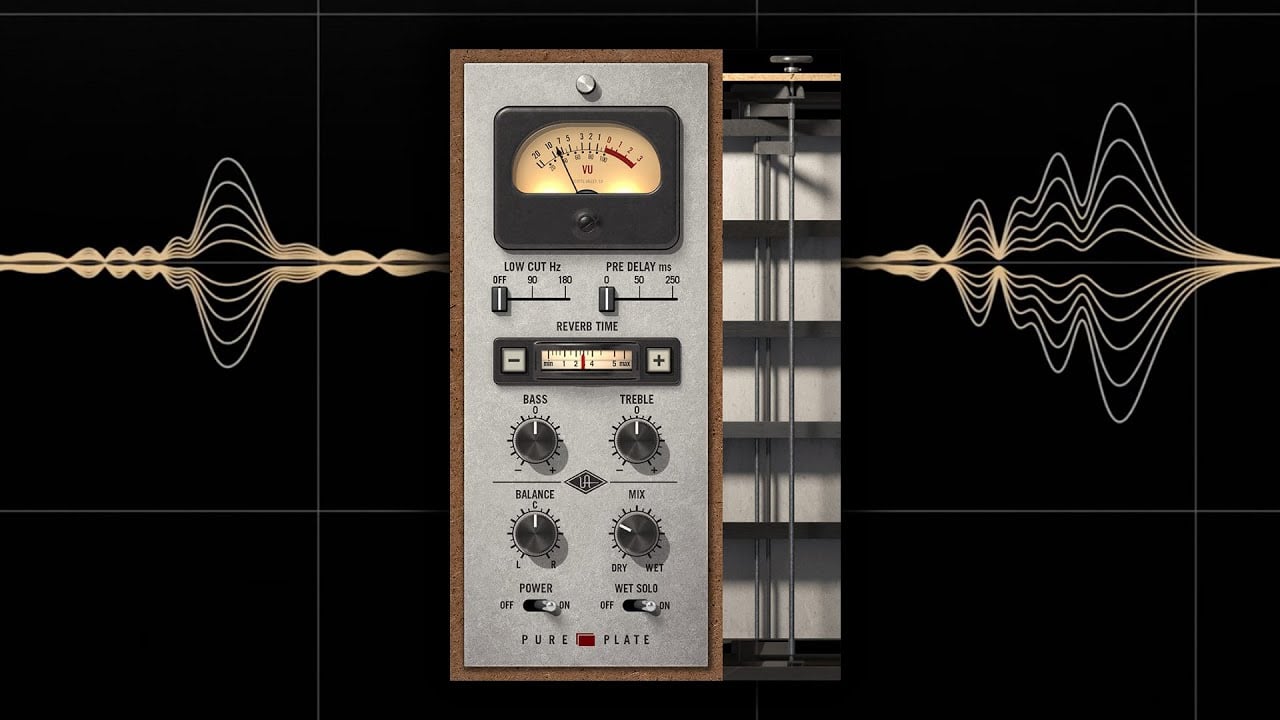
Pure Plate Reverb is a full commercial plate reverb from Universal Audio, free for good since April as part of the UAD Explore FREE bundle. It sounds great and doesn’t require ten minutes of tweaking to get a good result. It’s one of the better plate reverbs I’ve used in plugin form, and I love it.
You get one plate voice with a small set of controls, including Low Cut at 90 or 180 Hz, reverb time from 0.5 to 5.5 seconds, and Bass and Treble shelves on the reverb only. Artist presets from well-known engineers cover vocals, snare, drum bus, and more.
The result is a warm plate that sits surprisingly well behind a vocal without muddying it. Note that Wet Solo is on by default, making the plugin 100% wet and disabling the Mix knob; that’s ideal on a send, but switch it off on an insert. The Mix knob is also logarithmic, so 12 o’clock is only about 15% wet.
If you want something even simpler, RO-GOLD by Black Rooster Audio is a free vintage plate with four controls and a warm, lush, remarkably expensive sound for a freebie. It needs a free Black Rooster account and a serial.
Pure Plate Reverb requires a UA account, the UA Connect app, and a free iLok account (no dongle). You must download within 90 days of claiming, or the license expires.
Runs on: Windows, macOS (VST3, AU, AAX)
What is free: a perpetual license for the full plugin; nothing is locked
Download: UAD Pure Plate Reverb
BPB Dirty Spring by Bedroom Producers Blog
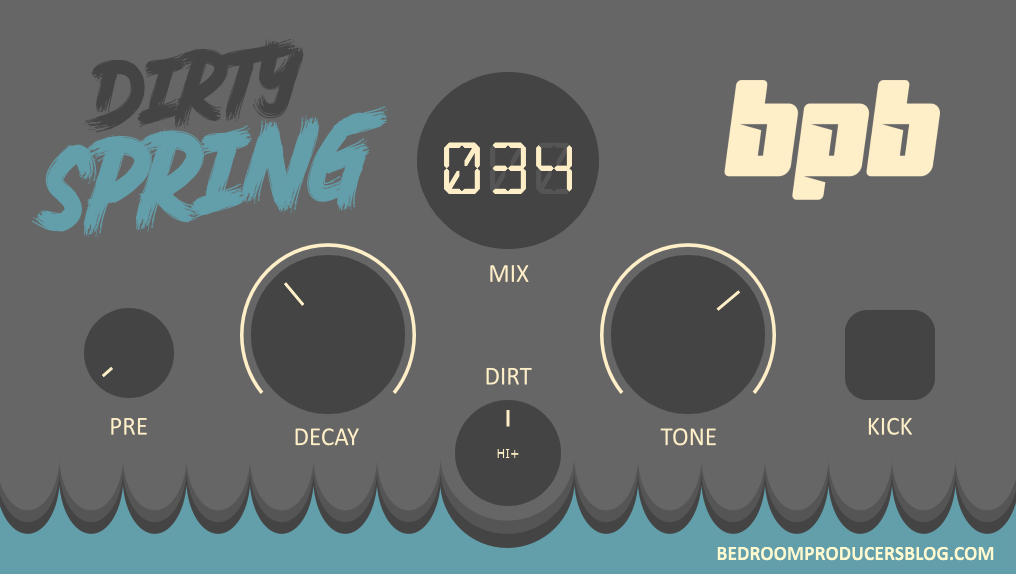
BPB Dirty Spring is proudly released for free by Bedroom Producers Blog, and I think its sound is great. It’s a spring reverb with a built-in bitcrusher that works on the reverb signal and is bypassed by default, so it can be a clean spring or a crunchy lo-fi one.
The Dirt knob has six bitcrusher settings, from subtle to over-the-top, and the Kick button simulates kicking the spring tank (you can automate it like a percussion hit). Decay goes up to 6 seconds and pre-delay up to a full second, long enough for echo effects.
I love crunchy-sounding spring reverbs, and Dirty Spring does wonders on drums and synths that lack character. It’s equally at home on guitars, pads, dub-style effects, and lo-fi vocals.
Runs on: Windows, macOS (VST, VST3, AU, AAX)
What is free: the full plugin; no authorization required
Download: BPB Dirty Spring
epicVerb mkII by Variety of Sound
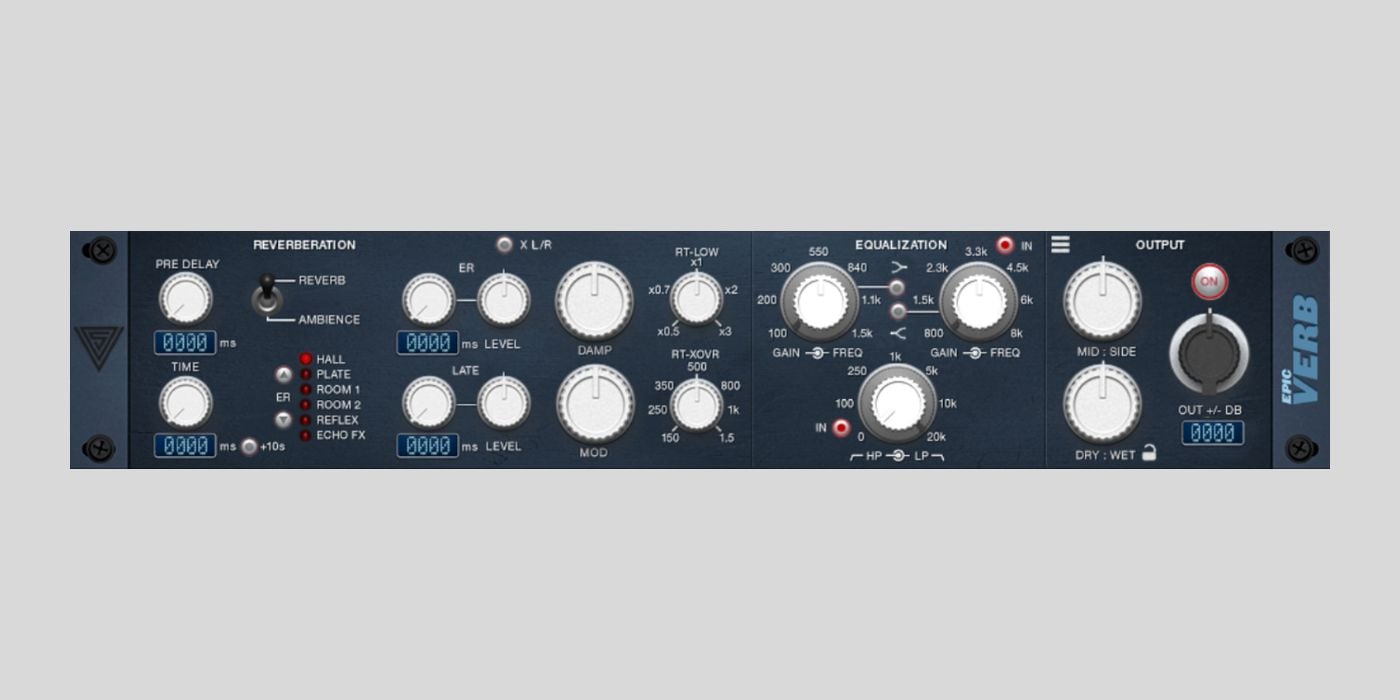
One of my favorite freeware reverbs from years ago is back. The original epicVerb came out in 2009, was discontinued in 2022, and returned after enough users asked for it. I’m glad it did, because I love this one; Variety of Sound plugins are a big part of why I keep a Windows laptop around.
It’s a reflection-based reverb for realistic rooms and halls with a slightly vintage hardware-like character. The six early-reflection models are Hall, Plate, two rooms, Reflex (which can fake spring-like effects), and Echo FX for ghostly delays.
Two onboard engines give it more variety. The ER reverb is strong, dynamic, and colored, while the new LATE reverb is smooth and neutral enough to give colorless vocal reverb on its own. Ambience mode gives early reflections only, for depth without tail buildup.
Tails run up to 10 seconds, with a +10s button for 10–20 second decays. There’s no installer, so you need to copy the plugin files into your plugin folder.
Runs on: Windows (VST, VST3)
What is free: the full plugin; no account, and there is no paid version
Download: epicVerb mkII
Raum by Native Instruments
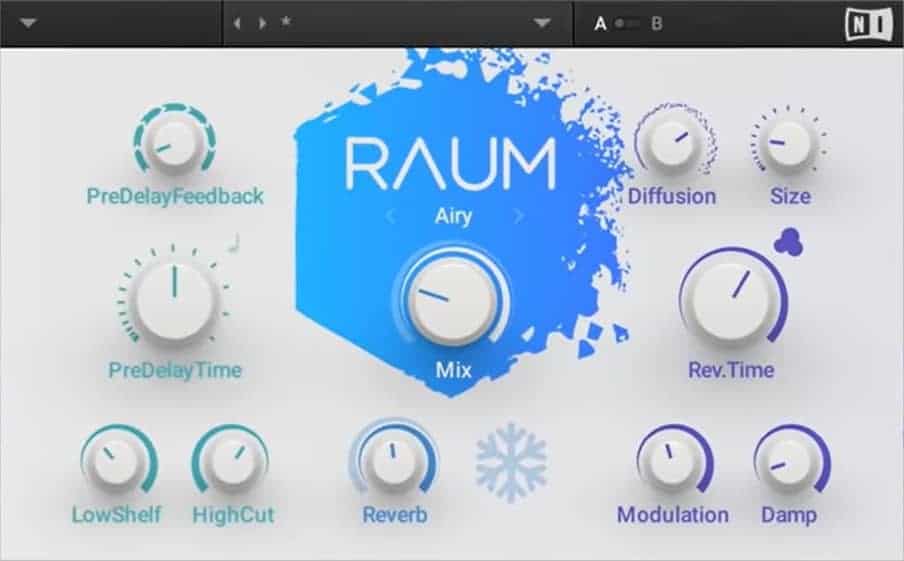
For sound design, Raum is still one of my favorite free reverbs, and I use it regularly. It’s quite versatile thanks to the included modes. Grounded is room-style, from tiny ambiances to large chambers; Airy is hall-style, ranging from medium chambers to large cathedrals (I love it on cinematic synths); and Cosmic is an abstract mode within the predelay’s feedback loop for metallic or grainy textures.
The predelay section is pretty wild. It runs from under a millisecond (perfect for weird effects on percussion) to two seconds, or syncs to tempo up to four bars. Feedback goes to 100% for endless repeats with a limiter keeping levels safe, and short predelay with high feedback turns Raum into a comb filter or resonator. Turn the Reverb knob down, and it becomes a clean echo.
Freeze (in Grounded and Airy) holds the reverb for as long as you like, creating instant drones and pads. Raum went from a 2019 giveaway to a paid plugin, then back to free in November 2023, and now has its own small download page, so you don’t need the whole Komplete Start bundle. The Native Access 2 installer, though, I find slow and clunky.
Runs on: Windows, macOS (VST3, AU, AAX)
What is free: the full Raum plugin; a free Native Instruments account and Native Access 2 are required, and it works offline after activation
Download: Raum
SOL by Dawesome and S1gns Of L1fe
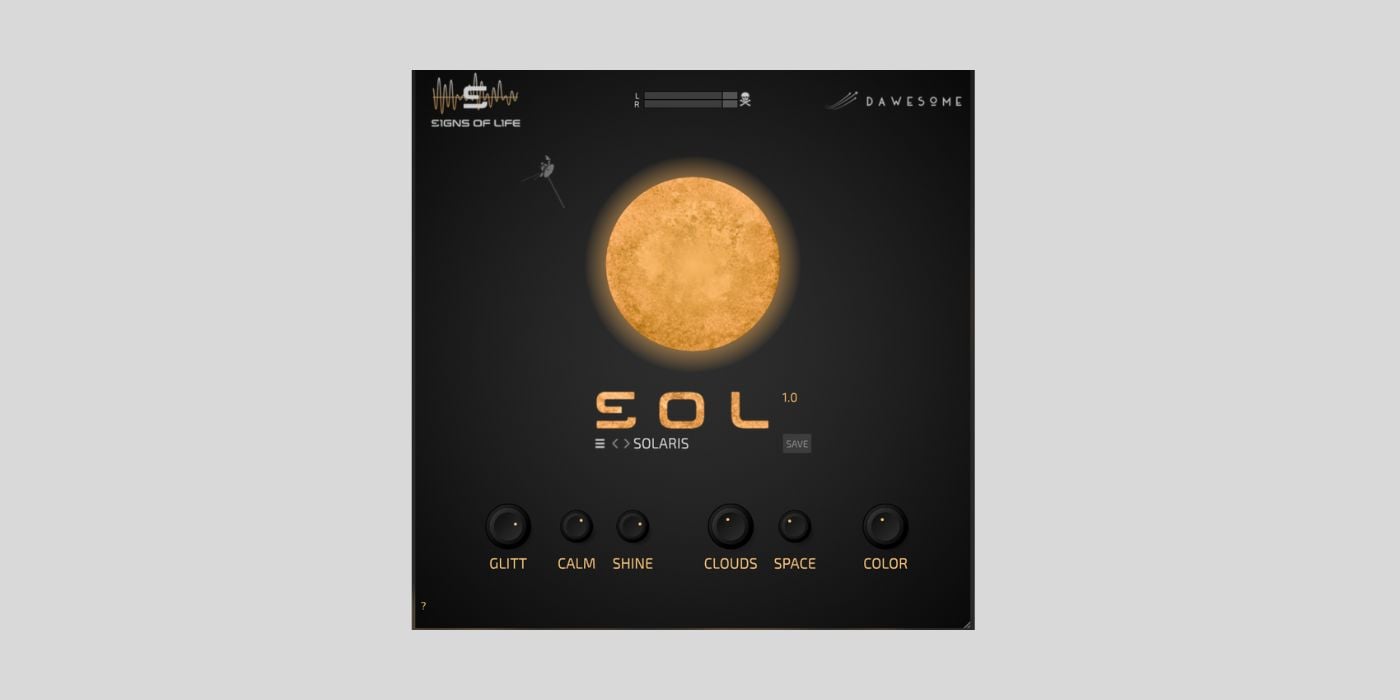
SOL pairs a granular layer called Glitter with an ambient reverb called Clouds, turning guitars, pads, plucks, drones, and field recordings into shimmering textures. It’s built for experimentation and adding texture rather than simulating realistic rooms.
Six knobs keep the workflow simple, despite the huge sound. Glitter adds the granular layer, Calm smooths it, Shine adds pitched grains an octave or two above, and Clouds, Space, and Color shape the reverb. The big sun in the middle is the dry/wet control. It’s the first plugin from ambient producer Chris Bryant (S1gns Of L1fe), made together with Dawesome.
The sound is good, though I’ll be honest, the interface isn’t my favorite.
If you want a different take on the same idea, Endless by DDMF is a free spectral and granular reverb for huge, ethereal, cinematic spaces, with a Sparkle and Detune section for shimmer tails. I love using it for experimental reverb effects, and it runs on Windows, macOS, and Linux with no account.
Runs on: Windows, macOS (VST3, AU, AAX)
What is free: the full plugin; no account, registration, or activation from Dawesome’s site
Download: SOL
Sala by Fors

Sala distills shimmer reverb down to five controls, with a deliberately surreal character. I think it sounds fantastic, and the minimal interface is wonderfully convenient and inspiring; with one algorithm and no presets, small moves make all the difference here.
The most interesting control is Zoom, which sets the input diffusion like a camera lens. The middle position softens the sound, higher values give a clearer result, and below the middle it turns into a swelling, reverse-like reverb. Tone is a staged low-pass filter, and Size changes how fast the reverb builds up.
Fors is the Swedish duo of Ess Mattisson (who worked on Elektron’s Digitone synth engine) and Felisha Ledesma, and Sala was their first native plugin, released as a free gift.
It is a bit heavy on the CPU but makes up for it with some incredible reverb sounds.
Runs on: Windows, macOS, Linux (VST3, CLAP; AU on macOS)
What is free: the full plugin; the free checkout asks for your name and email, no copy protection
Download: Sala
Shu by Mikey Audio
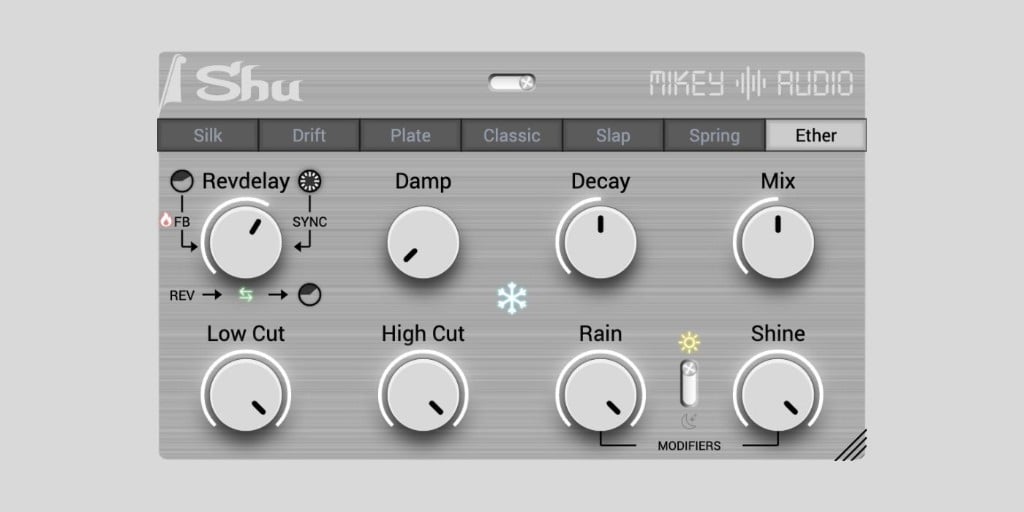
Shu packs seven completely different algorithms behind one simple set of controls, from the smooth Silk and the spacious Drift to a classic plate, a boingy spring, and Ether, a pitch-shifted shimmer. Switching modes crossfades without clicks, so you can audition them mid-playback.
I like this kind of workflow in a reverb plugin because I usually don’t want to adjust many parameters. Each mode adds two knobs of its own to five fixed ones, and there are no presets.
My favorites are Spring and Ether. Spring isn’t a particularly realistic emulation of an actual tank, but it has an interesting character, and I like adding it to synths and drums as a very subtle layer for a more organic feel.
Shu is not essential if your reverb shelf is already well stocked, but it’s a fun one to try and possibly keep.
Runs on: Windows, macOS, Linux (VST3, CLAP; AU on macOS)
What is free: everything, forever; no account or license key, donations welcome
Download: Shu
More free reverbs worth a look
- Ambient Reverb 7 by Stone Voices is an algorithmic true-stereo reverb with decays up to 100 seconds, and it’s excellent for ambient music. Free since June 2025, no registration, Windows and macOS.
- epicPLATE mkII and epicCLOUDS by Variety of Sound are more Windows-only freebies from the epicVerb developer. epicPLATE’s Drive knob is my favorite feature, and epicCLOUDS is worth a try if you like huge reverbs.
- Convology XT by Impulse Record and Wave Arts is a free convolution reverb that loads your own impulse responses (74 factory ones included), and it’s the most advanced free convolver I know. Free serial by email, Windows and macOS.
- Voyage Voyage by Musical Entropy is a shimmer reverb whose pitch-shifted tails run through a BBD-style delay; at full decay it’s a drone generator, and it’s simply fantastic for my sound design workflow. Windows, macOS, and Linux.
- WetReverb by WET VST is a free, open-source lo-fi reverb with an 80s digital character and 100% wet output, designed for sends. I really like it on drums, synths, and especially vocals. Windows, macOS, and Linux.
- Verberate Basic 2 by Acon Digital offers four fixed programs (Plate, Room, Hall, Lush Hall) plus a mix knob for quick and simple plug-and-play use. No registration, Windows and macOS.
- Galactic3 by Airwindows is a big reverb for pads and space ambient from the free and open-source Airwindows collection, without a custom interface. Windows, macOS, and Linux.
- TENS jr by Klanghelm is a free studio spring reverb with very high density and little of the usual boing, so it can sound almost like a plate. No copy protection, Windows and macOS.
Two plugins from older versions of this list are no longer free. Cloud Seed is now a paid plugin from Ghost Note Audio, with only an old Windows VST2 build from 2018 still available for free, and Eventide’s Temperance Lite was a limited-time giveaway in 2025 and is paid now.
Room, hall, plate, spring, or shimmer: which reverb type to use
A room reverb is short and dominated by early reflections. You should use it to add natural space and glue without an obvious tail. It’s good for drums, acoustic instruments, and dry vocals. But my pro tip is that less is more with room reverbs. On this page, look at OrilRiver, Dragonfly’s Room and Early Reflections, epicVerb mkII, Magic7’s rooms, and Shu’s Slap mode.
A hall is longer and smoother, with tails that build more slowly, and it suits strings, piano, pads, and more mellow sounds in general. OrilRiver, Dragonfly Hall, Magic7, epicVerb mkII, and Supermassive’s Sirius mode all cover it.
A chamber is the smooth middle ground between a room and a hall, and a classic choice for vocals and guitars. PSP Chamber and Magic7’s Chambers bank are the picks here.
A plate is bright, dense, and fast-building, with no distinct early reflections, and it’s still the go-to for vocals and snare. UAD Pure Plate, TAL-Reverb-4, Dragonfly Plate, RO-GOLD, Magic7’s Plates banks, and Shu’s Plate mode all qualify.
A spring reverb is twangy and boingy, the classic sound of surf guitar and dub, though I typically use it to add character to background vocals, leads, and other elements in the mix. BPB Dirty Spring and Shu’s Spring mode are the options here.
Shimmer, granular, and ambient reverbs add pitch-shifted, granular, or modulated tails that turn a source into a pad or texture. Supermassive, Raum, SOL, Sala, Endless, and Shu’s Ether mode live in this category.
Almost everything on this page is algorithmic, which means the size and decay are fully editable. Magic7 is the convolution-style exception, built from captures of real hardware programs with a fixed decay per program.
For more free effects, return to the Free VST Plugins hub and check the free delay plugins guide next. If you want to load your own impulse responses, the free convolution reverb guide has you covered.
Valhalla Supermassive is now the single top pick, seven free reverbs were added, and older plugins that are no longer updated, or that newer free reverbs outclass, moved to the short list above or were removed.
