


I tested every free orchestral VST plugin I could find in 2026 and picked the ones worth your hard-drive space for this guide.
Recording a real symphony orchestra is expensive. The best professional orchestral sample libraries cost thousands of dollars, and renting an actual orchestra costs even more. Free orchestral plugins won’t fully replace a $3,000 Hollywood scoring template, but I’ve found that the gap has narrowed over the last few years.
Two new releases make 2026 the best year yet to start an orchestral template without spending a cent. Spitfire Audio launched Spitfire Symphony Orchestra Discover in November 2025, and Sonuscore released LUX Orchestral Strings Elements in April 2026.
Alongside the older BBC Symphony Orchestra Discover, these three are the core of any free orchestral setup I’d build today.
This article covers the 17 best free orchestral VST plugins and sample libraries for your favorite DAW, plus a comparison table, quick-pick recommendations, an FAQ, and some tips for getting a convincing orchestral sound from free tools.
Best free orchestral VST plugins in 2026
- BBC Symphony Orchestra Discover
- Spitfire Symphony Orchestra Discover
- The Orchestra Elements
- LUX Orchestral Strings Elements
- The Free Orchestra 2
- Tutti Free
- Big Bang Orchestra
- Layers
- SINEfactory
- Synful Orchestra
- VSCO 2 Community Edition
- Soundpaint (free orchestral packs)
- Decent Sampler + Pianobook
- LABS (Splice INSTRUMENT)
- Virtual Playing Orchestra
- Sonatina Symphonic Orchestra
- One Track Orchestra
Free orchestral VST comparison
Here’s a quick overview of what you’re actually installing and what you need to run each one.
| Library | Host / engine | OS | Install size | Best for |
|---|---|---|---|---|
| BBCSO Discover | Spitfire plugin | Win / Mac (Apple Silicon) | ~240 MB | Best overall for beginners |
| SSO Discover | Kontakt Player 7.5.2+ | Win / Mac (Apple Silicon) | ~5.68 GB | Best free orchestral quality |
| The Orchestra Elements | Kontakt Player 6.7.1+ | Win / Mac | ~1–2 GB | Fast cinematic patterns |
| LUX Strings Elements | Kontakt Player | Win / Mac | ~3–6 GB | Cinematic strings section |
| The Free Orchestra 2 | Kontakt Player | Win / Mac | ~1–2 GB | Trailer and cinematic textures |
| Tutti Free | Kontakt Player 7.7.2+ | Win / Mac | ~445 MB | Aleatoric orchestral FX |
| Big Bang Orchestra | Synchron Player (iLok) | Win / Mac (Apple Silicon) | ~1.4 GB | Big tutti hits and swells |
| Layers | SINE Player | Win / Mac (Apple Silicon) | ~17 GB | Chord generation, Teldex tone |
| SINEfactory | SINE Player | Win / Mac (Apple Silicon) | Varies | Extra orchestral textures |
| Synful Orchestra | Standalone plugin | Win / Mac (Apple Silicon) | ~32 MB | Tiny RAM footprint, phrase intelligence |
| VSCO 2 Community Edition | SFZ or VST fork | Win / Mac / Linux | ~3 GB | Public-domain chamber orchestra |
| Soundpaint (free packs) | Soundpaint engine | Win / Mac | Varies | Ambient and hybrid textures |
| Decent Sampler + Pianobook | Decent Sampler | Win / Mac / Linux / iOS | Varies | Community-made string textures |
| LABS (Splice INSTRUMENT) | Splice INSTRUMENT | Win / Mac (Apple Silicon) | Varies | Free string textures, no Kontakt |
| Virtual Playing Orchestra | SFZ (Sforzando) | Win / Mac / Linux | ~618 MB | No-Kontakt, cross-platform |
| Sonatina Symphonic Orchestra | SFZ (Sforzando) | Win / Mac / Linux | ~1.39 GB | MuseScore and notation use |
| One Track Orchestra | VST | Win (64-bit status mixed) | Small | Legacy single-track sketching |
Which Free Orchestral VST Should You Choose?
Best overall: BBC Symphony Orchestra Discover. It’s the fastest way to get a decent-sounding orchestra into your DAW. The plugin is Spitfire’s own (no Kontakt needed), installs in about 240 MB, and includes 34 BBC Symphony Orchestra instruments plus a free Steinway Model D piano.
Best-sounding free orchestra: Spitfire Symphony Orchestra Discover. Released in November 2025, SSO Discover gives you 44 instruments from the AIR Studios-recorded Spitfire Symphony Orchestra, with dynamic layers, round robins, and three legato patches. It’s the deepest free orchestra on this list, though the 5.68 GB download and Kontakt Player requirement make it a bigger commitment than BBCSO Discover.
Best for fast cinematic sketches: The Orchestra Elements by Sonuscore. The Ensemble Engine generates full arpeggiated orchestral patterns from a single MIDI part, which is perfect for blocking out cue ideas.
Best for cinematic and trailer music: The Free Orchestra 2 by ProjectSAM. The 12 instruments (plus the 14 from the original Free Orchestra) are pulled straight from Symphobia and related ProjectSAM libraries.
Best for strings: LUX Orchestral Strings Elements. A 70-piece symphonic ensemble with four articulations per section, all from the same recordings as Sonuscore’s $499 LUX library.
Best for aleatoric orchestral FX: Tutti Free by Sonokinetic. Stabs, crescendi, textures, and glissandi from a full symphony orchestra improvising in a concert hall.
Best for big tutti hits and swells: Big Bang Orchestra by Vienna Symphonic Library.
Best for ambient and hybrid scoring: Soundpaint’s free Adastra String Ambiences and LABS Frozen Strings / Scary Strings.
Best on a low-spec machine: Synful Orchestra. The plugin uses about 32 MB of RAM because it synthesizes phrasing rather than streaming samples.
Best for MuseScore, notation software, and Linux: Sonatina Symphonic Orchestra and Virtual Playing Orchestra. Both are SFZ-based and run anywhere Sforzando runs.
BBC Symphony Orchestra Discover
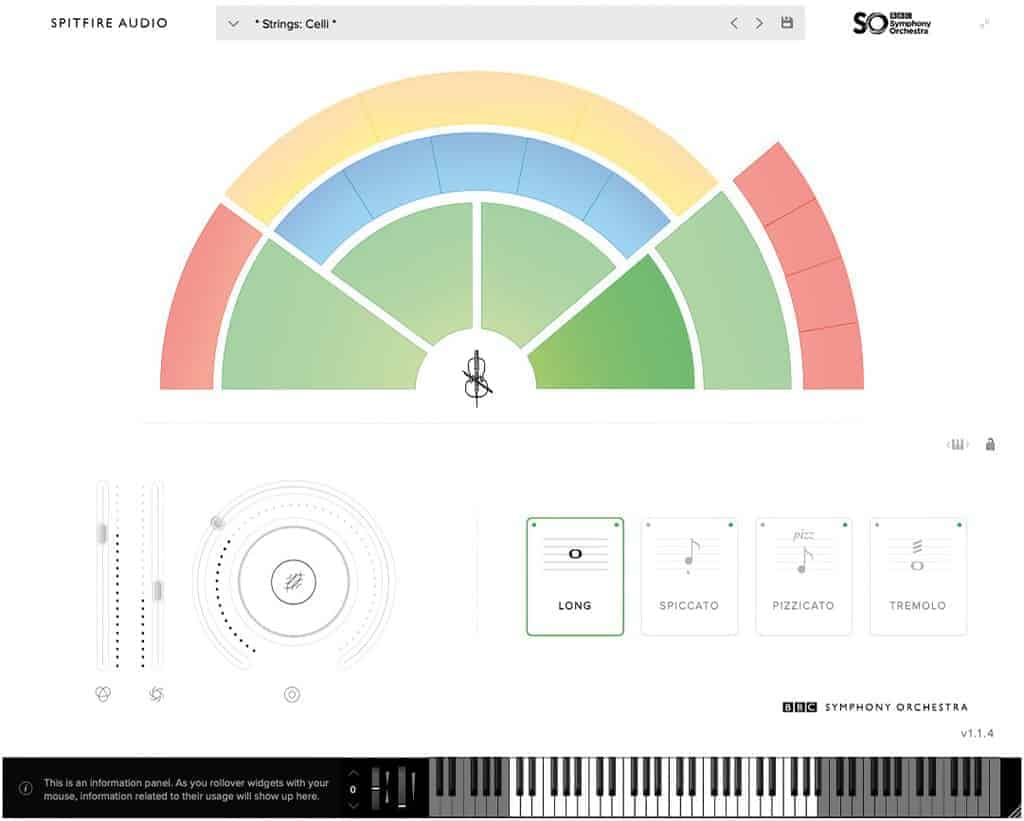
BBC Symphony Orchestra Discover is the best free orchestral VST plugin in 2026, and the first thing I’d install on a fresh system.
It’s the entry-level free tier of Spitfire Audio’s flagship BBCSO library, recorded at the BBC’s Maida Vale Studios in London. You get 34 BBC Symphony Orchestra instruments covering strings, brass, woodwinds, and percussion, plus 47 techniques. Spitfire added the free BBCSO Piano (a Steinway Model D) as a Discover-tier add-on, so you also get a concert grand in the same plugin.
The whole thing installs in around 240 MB and runs inside Spitfire’s own plugin in AU, VST2, VST3, AAX, and standalone formats on Windows and macOS. It’s Apple Silicon native from v1.4.0 onward. A free Spitfire account is required, but there’s no email newsletter gate.
What you’re giving up compared to the paid Core and Professional tiers is a single stereo mix signal (no mic mixing), one dynamic layer, no round robins, and no legato patches. Everything plays back as one dynamic no matter how gently you play. That said, it still sounds like a real BBC orchestra recorded in a real hall, which is more than almost any other free library can claim.
If you already own BBCSO Core or Professional, Spitfire gives you Discover for free automatically.
Download: BBC Symphony Orchestra Discover
Spitfire Symphony Orchestra Discover
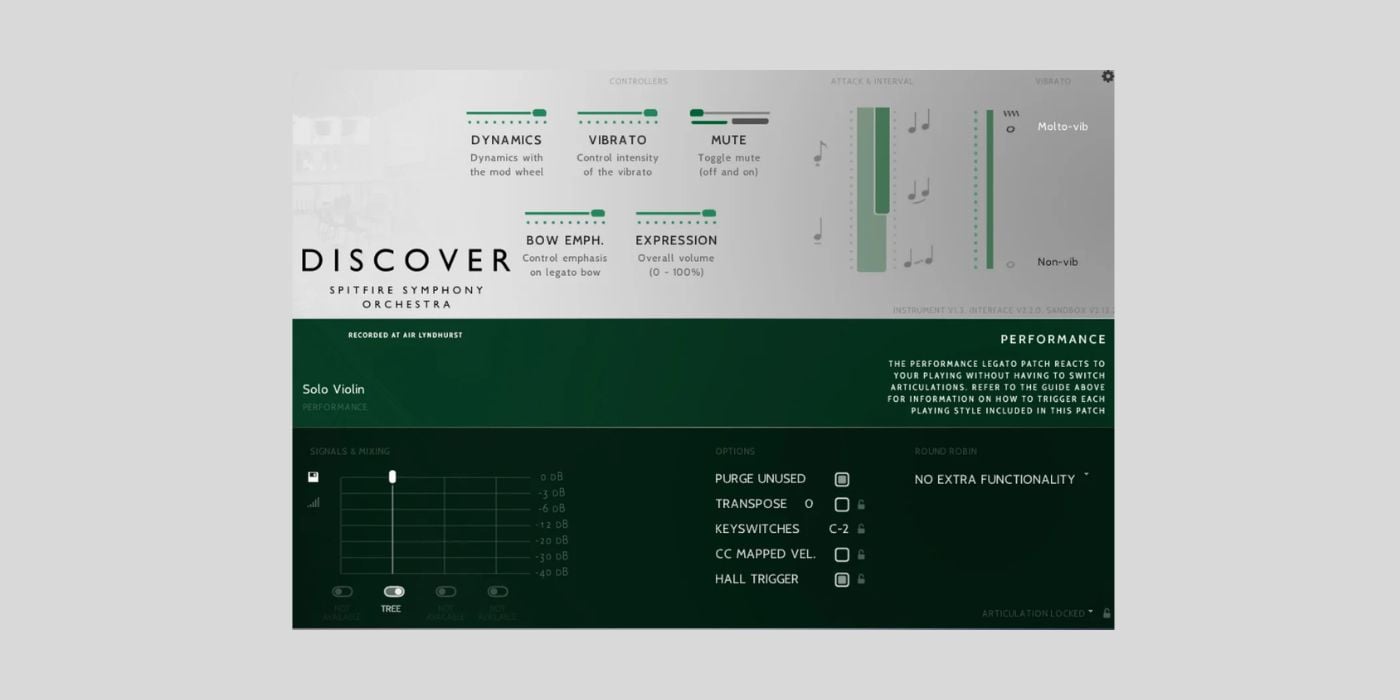
Spitfire Symphony Orchestra Discover is Spitfire’s largest free library to date and a separate product to BBCSO Discover. Released in November 2025, it brings 44 instruments from the paid Spitfire Symphony Orchestra to the free Kontakt Player.
It was recorded at AIR Studios Lyndhurst Hall, the same London scoring stage used for Interstellar, Inception, and The Dark Knight. That hall is famously large and airy, and its character is baked into every sample. You can’t remove it, so SSO Discover sounds cinematic and wet out of the box, whether you want it to or not.
You get 73 techniques, up to four dynamic layers, up to two round robins per instrument, and three performance legato patches (Solo Violin, Horn Solo, and Cor Anglais). There are also 11 solo instruments and 9 orchestrated ensembles.
Install size is around 5.68 GB, and you need Kontakt Player 7.5.2 or later to run it. Unlike BBCSO Discover, there’s no dedicated Spitfire plugin for this one. The download is free but gated behind Spitfire’s email newsletter subscription.
I think of BBCSO Discover and SSO Discover as complementary rather than competing. BBCSO Discover is what I install first because it’s smaller and loads fast. SSO Discover is the one I reach for when I need dynamic expression, legato lines, and a fuller orchestral sound behind the cue.
Download: Spitfire Symphony Orchestra Discover
The Orchestra Elements

The Orchestra Elements is Sonuscore’s free entry-level version of The Orchestra Complete, their 80-player paid orchestral library. It runs in the free Kontakt Player (version 6.7.1 or later) and requires a free Sonuscore account plus Native Access registration.
You get 25 string articulations, 9 brass articulations, 12 wind articulations, playable percussion, and a choir preset.
The headline feature is Sonuscore’s Ensemble Engine, which lets you load up to five instruments at once and assign an arpeggiator or envelope to each. One MIDI chord from your keyboard becomes a full arpeggiated orchestral texture with shifting dynamics tied to your mod wheel.
It’s the fastest way I know to get an orchestral cue sounding good without writing every part by hand. Sonuscore designed it around beginners, but I still use it when I need to block out a cinematic idea in ten minutes.
One limitation worth knowing about is that the preset mode is locked to 4/4. If you’re working in 3/4 or 7/8, you’ll need to program your own arpeggiator patterns or switch to a different tool.
Download: The Orchestra Elements
LUX Orchestral Strings Elements
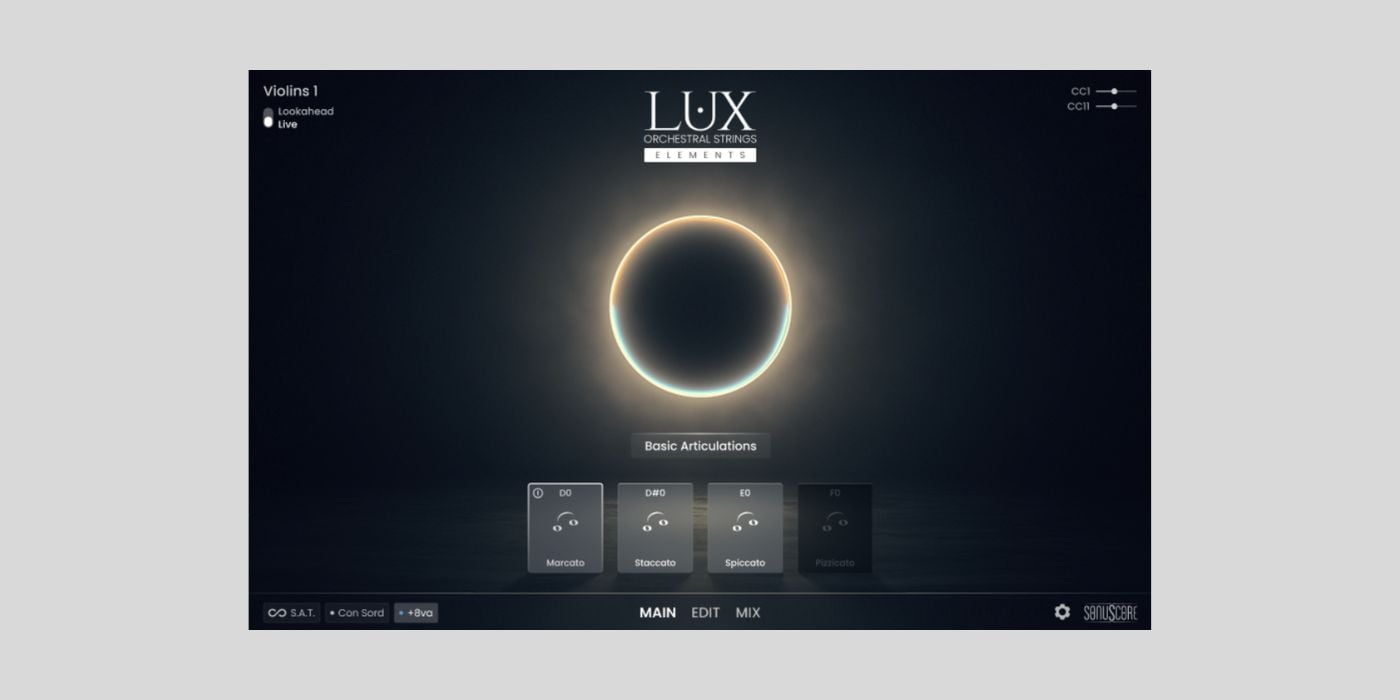
LUX Orchestral Strings Elements is the newest free library on this list. Sonuscore released it on April 9, 2026, as the free teaser version of their $499 LUX Orchestral Strings library.
The important part is that it uses the same source recordings as the paid version, not a stripped-down demo session.
The library captures a 70-piece symphonic string ensemble recorded on a large scoring stage. You get all five string sections (1st Violins, 2nd Violins, Violas, Celli, and Basses), each with four articulations: Sustain, Spiccato, Tremolo, and Sul Ponticello Tremolo.
The Sul Ponticello Tremolo is an unusually sophisticated articulation for a free library. It’s the glassy texture you get from bowing close to the bridge, and I love how it’s the perfect fit for horror and thriller cues.
There’s also a 1st Violin Legato Demo patch, but it’s a playback preview of the paid legato engine rather than a fully playable compositional tool.
LUX Strings Elements runs in the free Kontakt Player, which means no full Kontakt license is required. Four articulations with a full 70-piece ensemble per section is enough to write complete string cues without needing another library underneath.
Most importantly, this is a free string section you can actually use in a track, not a watered-down advertisement for the paid version.
Download: LUX Orchestral Strings Elements
The Free Orchestra 2
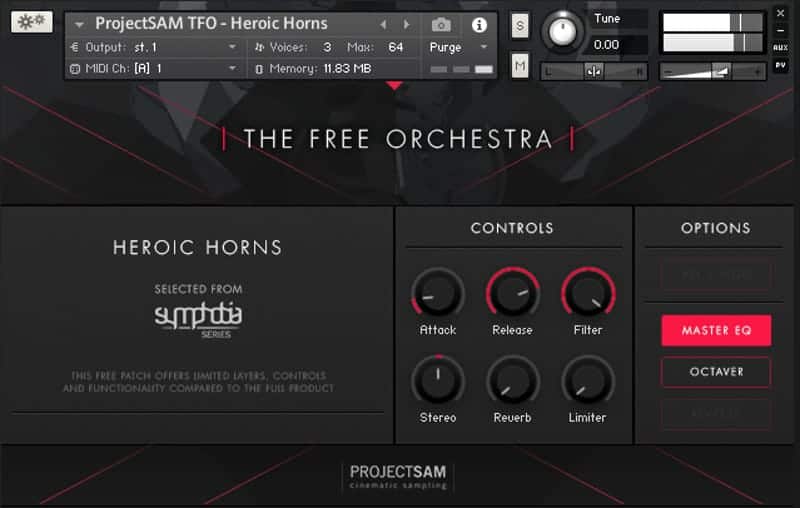
The Free Orchestra 2 by ProjectSAM is the cinematic tool I pull up when I need something quick and lightweight for a trailer-style texture.
It’s a free Kontakt Player library with 12 curated instruments drawn from ProjectSAM’s commercial catalog, including Symphobia, Trailer Brass, and Colors.
ProjectSAM added one new instrument per month between August 2023 and August 2024, and the series is now complete with 12 instruments. Combined with the original Free Orchestra (14 instruments after the v2.0 update with sounds from Symphobia 3 and 4), you get 26 cinematic instruments for free.
My favorites include Sul Tasto Strings for warm legato-style textures, Bold Legato Brass for heroic lines, and Tutti Crescendo, which uses Adaptive Sync to lock the crescendo phrase to your session tempo. Haunting Horns and Dystopian Bow are also very good for tension cues.
The samples are pulled directly from ProjectSAM’s paid catalog and presented in a simplified interface. The in-app preview lets you audition before loading, which saves time when you’re scanning 26 presets looking for the right flavor.
To use it, you’ll need a ProjectSAM account, a Native Instruments account, and Kontakt Player 6.5.3 or later.
Download: The Free Orchestra 2
Tutti Free

Tutti Free by Sonokinetic is a 445 MB Kontakt Player library of aleatoric orchestral effects. It captures a full orchestra — 52 strings, 12 woodwinds, 11 brass, plus piano, celesta, and percussion — improvising atonal phrases in situ at the Cinematic Concert Hall in Zlín, Czech Republic.
The content is organized into four phrase categories: Hits and Stabs, Textures, Crescendi, and Glissandi. Structured phrases show you a visual notation of exactly which instruments were used, and the aleatoric “random” phrases are improvised without notation. Mic mixing is a fixed blend of Close, Decca, Wide, and Balcony signals.
I’ve used Tutti Free on several hybrid cinematic projects as both an SFX source and a subtle layer of orchestral percussion. It’s not a melodic or harmonic tool, and it won’t help you write a theme.
But for tension risers, trailer stabs, horror pads, and any situation where you need authentic orchestral chaos, it’s one of the most useful free libraries I own.
You’ll need a free Sonokinetic account and the free Kontakt Player (version 7.7.2 or later as of 2025). Komplete Kontrol and NKS are both supported.
Download: Tutti Free
Big Bang Orchestra
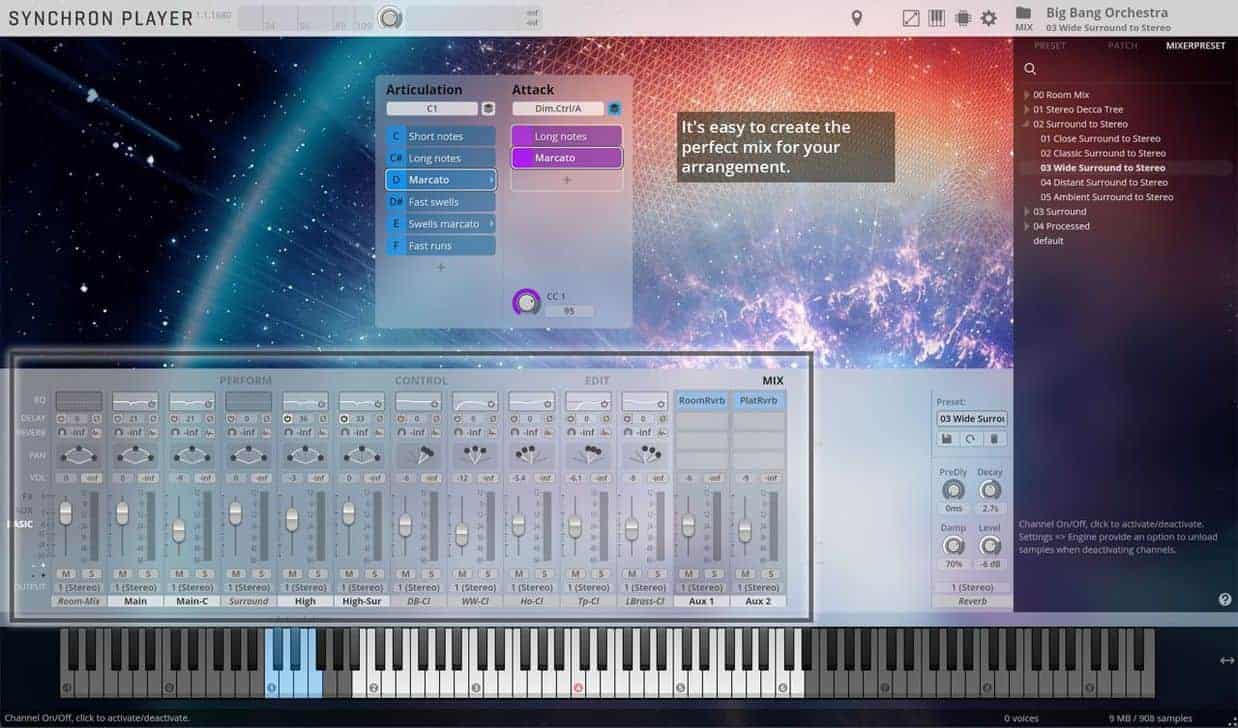
Big Bang Orchestra by Vienna Symphonic Library is a free tutti orchestral library recorded at VSL’s own Synchron Stage Vienna.
Every sound you hear is the whole orchestra playing the same phrase at once, which makes it ideal for cinematic impacts, swells, and slams, but useless for melodic section writing.
The original 2019 release required a physical eLicenser dongle. That’s no longer the case. VSL migrated fully to iLok in 2023, and as of 2026, you just need a free VSL account, the free iLok License Manager, and a free iLok account.
The free Synchron Player downloads through the Vienna Assistant app, which handles everything automatically. Apple Silicon is natively supported.
The core BBO install is around 1.4 GB and includes short notes, long notes, fast swells, fast runs, marcatos, and marcato swells across three velocity layers and ten microphone positions (plus one surround position). Vienna released an update in April 2026 that expanded the content further.
What really sells Big Bang Orchestra for me is the free bundle that comes with it. Once you’re in the VSL ecosystem, you can also install free Celestial Strings, Violin Runs, Angelic Choir, Harp Glissandos, Small Percussion, Space Organ, Soft Imperial piano, and Fujara Flute through Vienna Assistant.
That’s a lot of usable orchestral material on offer for free.
Download: Big Bang Orchestra
Layers
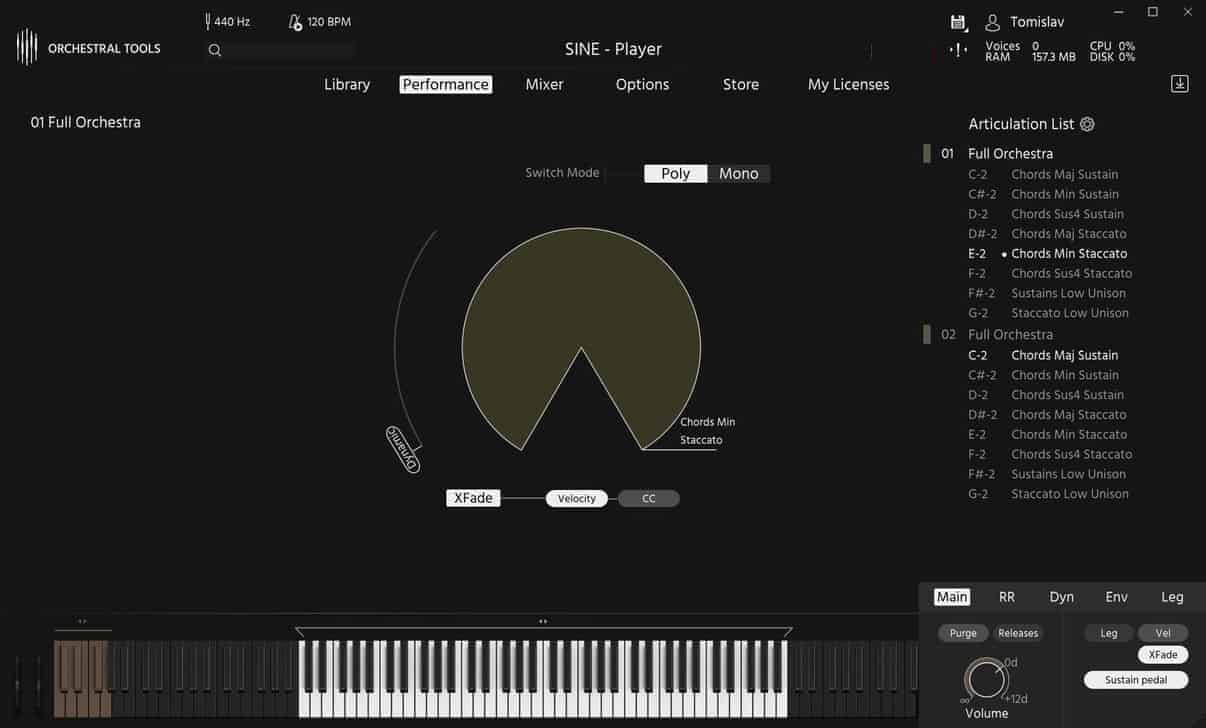
Layers by Orchestral Tools is a free orchestral library recorded at Teldex Scoring Stage in Berlin — the same room behind OT’s premium Berlin Series. It runs in the free SINE Player and gets added to your account automatically when you download anything else from Orchestral Tools.
The library includes a full orchestral patch plus individual strings, woodwinds, and brass sections, each with several articulations.
The signature feature is chord generation: play a single MIDI note, and Layers triggers a full major, minor, or suspended chord with multiple inversions available. You also get multiple mixable mic positions, which is rare for a free library.
Install size is around 17 GB of underlying samples (compressed to roughly 10 GB in the SINEarc format). That’s a lot of space for a free library, but the sound quality matches OT’s commercial output.
The one catch is that the SINE Player has well-documented bugs in FL Studio. I’ve seen reports of sticky notes, erratic key mappings, and black keys triggering notes two or three octaves higher. Orchestral Tools’ official recommendation is to use a fixed buffer size and enable “Align tick lengths” in FL.
If you’re on another DAW, like me, you’ll likely be fine.
Download: Layers
SINEfactory
SINEfactory is Orchestral Tools’ growing collection of free original instruments for the SINE Player. New titles have been added since the January 2021 launch, and all of them stay free forever.
Unlike Layers (which is a curated orchestral library), SINEfactory is a mixed bag of instruments that happens to include some useful orchestral content.
The current roster includes Ratio (Steinway B grand piano recorded at Sunset Sound), Gearbox (studio percussion), Helix (a string ensemble with sustains and spiccatos from the Berlin Series), Crucible (a Baroque-style church pipe organ from a Gothic church in southern Germany), Spindle (a felt piano), and several others like Strand (nylon guitar), Formby (ukulele), Dynamo (udu percussion), and Crux (a J-Bass).
Helix and Crucible are the two instruments I reach for in an orchestral context.
Helix sits nicely underneath a polished string library when you want an extra octave of ensemble sustain, and Crucible works great for solo cathedral-style organ lines.
If you’re already running SINE Player for Layers, SINEfactory is free extra content with zero additional setup.
Download: SINEfactory
Synful Orchestra
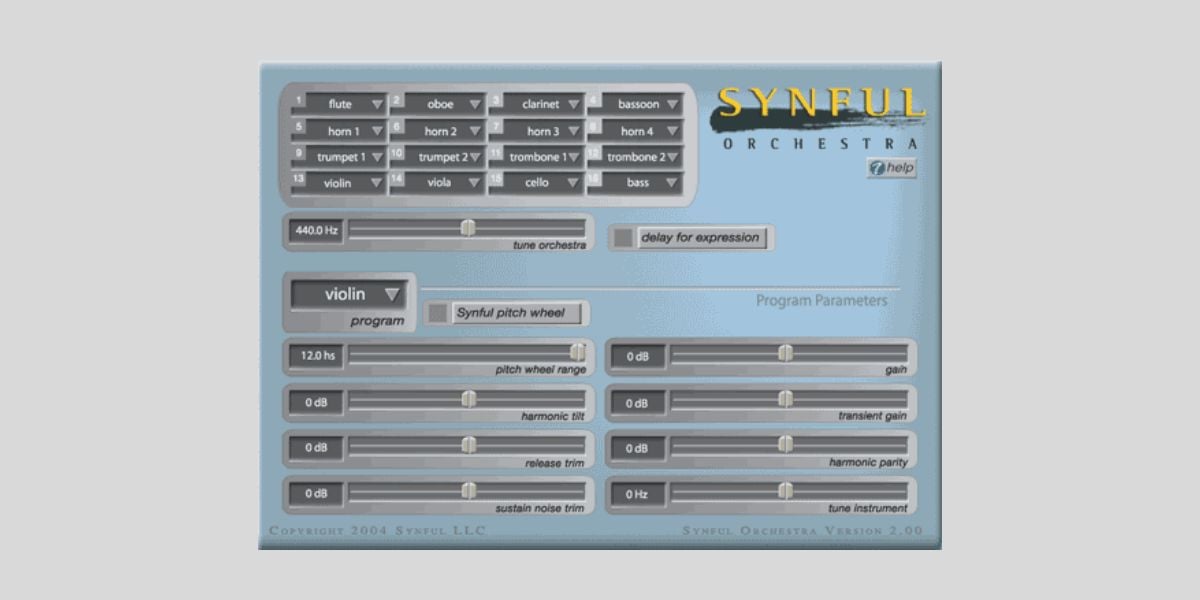
Synful Orchestra is a pretty strange orchestral plugin, but in a good way. Created by Dr. Eric Lindemann and sold commercially for $479 from 2004, it was released as freeware in August 2023 with no activation, no account, and no restrictions whatsoever.
Instead of streaming audio samples, Synful uses a proprietary technique called Reconstructive Phrase Modeling (RPM). It synthesizes orchestral phrasing from a 32 MB phrase database by analyzing your incoming MIDI data. Legato, staccato, marcato, portamento, and vibrato transitions are all handled automatically from a single continuous expression curve. No keyswitches.
The included instruments are flute, oboe, cor anglais, clarinet, bassoon, horn, trumpet, trombone, violin, viola, cello, and double bass. Version 2.7 and later support AU, VST, VST3, and AAX in 64-bit only, and there’s a native Apple Silicon build.
Synful isn’t going to outperform a modern sample library on realism. The tone is thin in the way the 2004 synthesis tends to be. But the intelligent phrase modeling produces legato transitions that sample libraries still struggle with, and the 32 MB RAM footprint makes it viable on machines where a full Kontakt library would choke.
It’s worth having installed for the technology alone.
Download: Synful Orchestra
VSCO 2 Community Edition
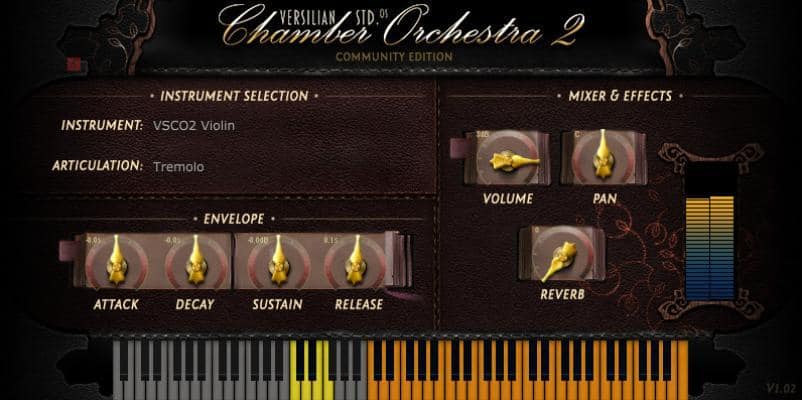
VSCO 2 Community Edition by Versilian Studios is an open-source chamber orchestra under the CC0 license, which means it’s public domain.
What I love here is that there’s no signup email, no account, no attribution required, and no restrictions on commercial use or redistribution. That’s rare in the sample library world.
The core library includes about 1,952 samples covering flute, clarinet, trumpet, trombone, tuba, organ, piano, percussion, and strings (violin, viola, cello, double bass). Recordings are 24-bit, 44.1 kHz, with a chamber-scale, slightly dry character.
I find it much more intimate than the huge, scoring-stage sound of the BBCSO or SSO Discover.
The official release is SFZ and WAV files, playable in any SFZ host. Plogue’s free Sforzando is the easiest entry point. Several third-party conversions exist:
- bigcat Instruments’ VSCO2 Rompler — 64-bit VST for Windows and AU for Mac.
- bigcat Instruments’ Sketching Chamber Orchestra — Kontakt 5.6.8+ (full version required, not Kontakt Player). Adds scripted legato, mod wheel crossfading, convolution reverb, and ensemble patches.
- Virtual Playing Orchestra — the most refined SFZ-based build, included separately on this list.
Because the license is CC0, VSCO 2 CE is also used as a building block for custom instruments, game audio, and app development.
Download: VSCO 2 Community Edition
Soundpaint (free orchestral packs)

Soundpaint is a free sample engine developed by Troels Folmann, one of the founders of 8Dio. The engine renders up to 127 dynamic velocity layers in real time, which gives the sounds a continuous, analog-style response that samplers like Kontakt don’t replicate. The engine runs as VST, VST3, AU, and AAX, plus a standalone.
On the orchestral side, Soundpaint’s free catalog leans more towards ambient textures than playable sections, but what’s there is worth installing:
- Adastra String Ambiences — violins, violas, cellos, and basses from the Adastra strings sessions, transformed into ambient soundscapes. Atmospheric but not melodically playable.
- Free Angels — a lush, layered pad built by 100 sound designers.
- Free Radicals — dark, twisted sound-design textures for tension and glitch work.
These are cinematic layering tools rather than full orchestral instruments, and they work best underneath or alongside something more traditional. I like using Adastra String Ambiences to add weight under written string parts, or to create a bed of tension before a cue resolves.
If you want traditional Soundpaint orchestral content like Adastra Ensemble Strings or CAGE Brass, those are paid products.
Download: Soundpaint
Decent Sampler + Pianobook

Decent Sampler is a free, cross-platform sample player plugin created by David Hilowitz. It’s available for Windows, macOS, and iOS, and runs in VST, VST3, AU, and AUv3.
On its own, it’s just an empty player, but paired with Pianobook, it opens up one of the largest collections of free community-made instruments on the internet.
Pianobook was founded by Christian Henson (co-founder of Spitfire Audio) as a platform for creators to share sampled instruments. There are hundreds of free libraries available, many of them in Decent Sampler format.
For orchestral work, the standout free Pianobook libraries in 2026 include:
- NFO Alternative Chamber Strings (Longs & Shorts) — recorded by the Northern Film Orchestra in Manchester. Chamber strings with four mic positions (Close, Stereo Pair, Outriggers, Room). Professional-quality recordings and my favorite Pianobook orchestral pack.
- Soft String Spurs — a viola library with four dynamic layers, including sustains, harmonics, and swell components.
- Found Strings — a chromatic symphonic strings library sampled by Christian Henson.
- Flute and Violin — a combined flute and violin duet library with a natural, intimate character.
Decent Sampler is limited compared to Kontakt. It doesn’t have a true legato engine, round robin management is basic, and you can’t mix multiple mic positions within a single patch.
For intimate textures, ambient scoring, and indie film, that’s fine. For a polished orchestral mockup with articulation switching and keyswitched legato, you’ll want one of the Kontakt Player libraries further up this list.
Download: Decent Sampler + Pianobook
LABS (Splice INSTRUMENT)

LABS by Spitfire Audio launched in 2016 as a free instrument series. The situation got complicated in October 2025 when Splice acquired Spitfire Audio, and the LABS catalog migrated into a new free plugin called Splice INSTRUMENT.
The standalone LABS installer still works in parallel, and every previously free LABS pack stays free forever.
On the orchestral side, the packs worth installing are:
- LABS Strings and LABS Strings 2 — two string ensembles recorded at Spitfire’s HQ.
- LABS Frozen Strings — a six-player ensemble with a standout super sul tasto sound. This library was the inspiration for Spitfire’s premium Albion V Tundra.
- LABS Scary Strings — slow, evolving, haunting textures for horror and thriller scoring.
- LABS Cello Moods and LABS Amplified Cello Quartet — two different takes on cello textures.
- LABS Harmonic Flights — harmonic-focused string textures for ambient writing.
- LABS Choir — atmospheric choir textures.
A word of warning: the Spitfire plugin has a long history of needing an internet connection to load, and I’ve seen reports of recurring bugs with files disappearing after app updates.
Splice INSTRUMENT reportedly resolves some of these issues by auto-detecting existing LABS libraries, but if you score professionally and need reliable offline instruments, you should test before committing.
Note that Symphonic Violins & Violas and Symphonic Celli & Basses (released October 2025) are paid premium LABS+ content and require a Splice INSTRUMENT subscription.
Download: Spitfire LABS
Virtual Playing Orchestra
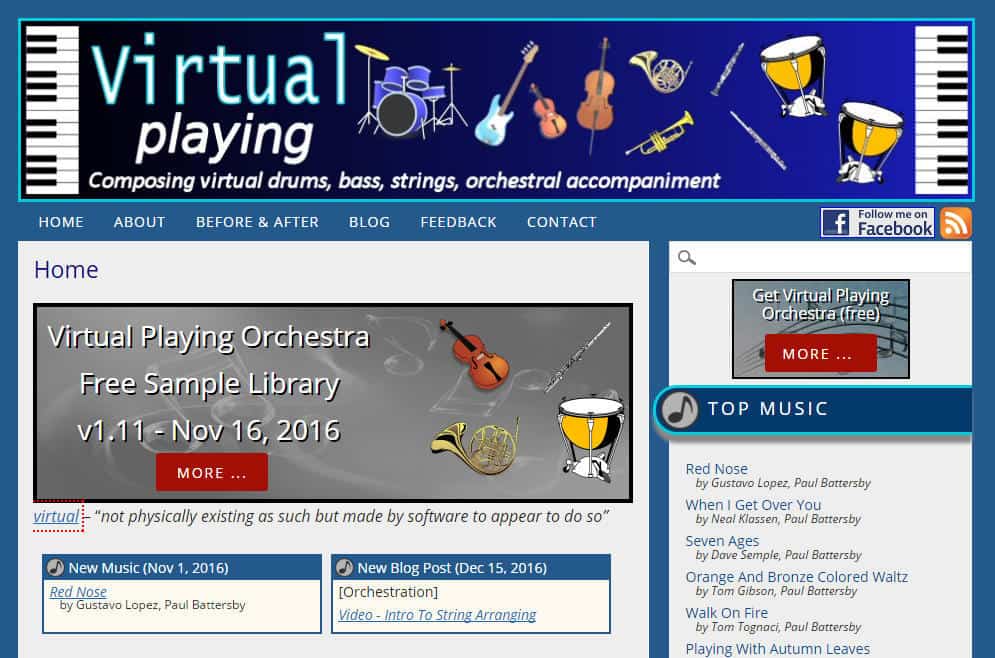
Virtual Playing Orchestra is an SFZ-based free orchestral library maintained by Paul Battersby.
It’s a curated compilation of samples from Sonatina Symphonic Orchestra, VSCO 2 Community Edition, and the University of Iowa’s public-domain recordings, processed and optimized by Battersby for cohesive playback.
You get section and solo instruments for woodwinds (flute, oboe, clarinet, bassoon), brass (trumpet, horn, trombone, tuba), strings (violin, viola, cello, double bass), and percussion (timpani, snare, bass drum, and more). Two SFZ script sets are included: a Standard Orchestra with straightforward mapping, and a Performance Orchestra that uses mod wheel and velocity to switch articulations on the fly.
Install size is around 618 MB, which is remarkably light for a full orchestral library. Battersby recommends running it in Plogue Sforzando (free), though it’ll also work in sfizz, ARIA Player, or any SFZ-compatible host.
The downside is that the underlying samples come from multiple sessions recorded in different rooms, so you’ll want to sit everything into a single hall reverb to unify the sound. Cohesion isn’t as clean as a single-session library.
For MuseScore users, Reaper users, Linux composers, and anyone who wants a no-Kontakt, no-account, no-email option, Virtual Playing Orchestra is the best SFZ orchestra in town.
Download: Virtual Playing Orchestra
Sonatina Symphonic Orchestra

Sonatina Symphonic Orchestra is a somewhat old free orchestral SFZ library.
Mattias Westlund created the original in 2011, and Peter Eastman has been maintaining and expanding it for years. The current version is 4.0 at 1.39 GB, and it’s licensed under CC Sampling Plus 1.0 (free for commercial use with attribution).
Version 4.0 now covers ensemble and solo instruments for strings, winds, brass, and percussion, plus piano, harpsichord, and chorus. Eastman’s key contribution over Westlund’s original has been looped sustains, which dramatically improve the library for sustained orchestral writing. By modern bedroom producer standards, Sonatina is pretty dated, but it’s still useful as a free, cross-platform fallback.
Where it still shines is in notation software. MuseScore, Sibelius, and Dorico users get a free, cross-platform orchestra that runs anywhere Sforzando or sfizz runs, including Linux.
It’s also the fallback when Kontakt Player isn’t an option. If you need production-grade orchestral sound, BBCSO Discover and SSO Discover are meaningfully better, but Sonatina remains the reliable SFZ benchmark.
A community-made SF2 conversion also exists for MuseScore users who prefer the soundfont format.
Download: Sonatina Symphonic Orchestra
One Track Orchestra
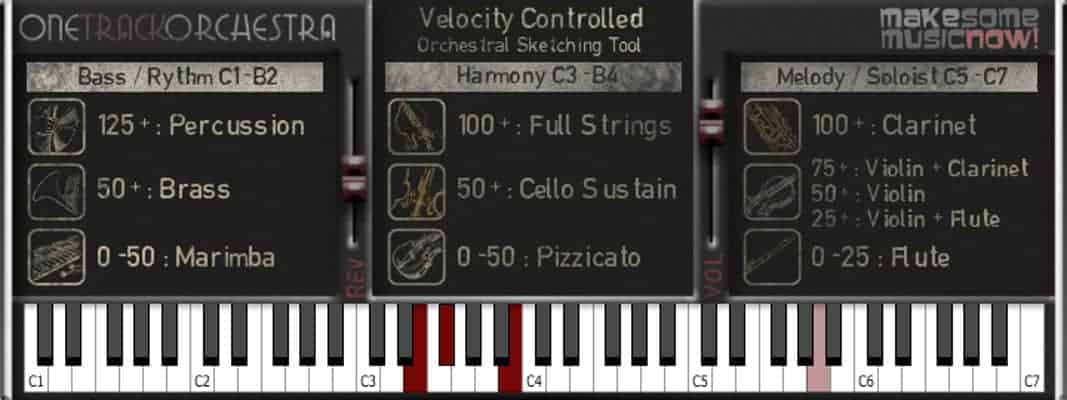
One Track Orchestra by Make Some Music Now is a simple freeware orchestral sketching plugin based on VSCO 2 Community Edition samples.
It maps strings, brass, woodwinds, and percussion to different keyboard zones so you can sketch an entire orchestral arrangement on a single MIDI track. The only controls on the interface are volume and reverb sliders.
The underlying VSCO 2 CE samples are the same ones you can get in more polished formats (bigcat’s VSCO2 Rompler, Virtual Playing Orchestra, or Sketching Chamber Orchestra). For any modern workflow, BBCSO Discover is smaller to install, better sounding, and equally beginner-friendly.
I’m keeping it on this list because some producers specifically want the absolute simplest possible one-track orchestra sketch tool. If that’s you, fine. Otherwise, skip it.
Download: One Track Orchestra
Budget-Friendly Orchestral Alternatives
If you’ve outgrown the free libraries and want to step up, BBC Symphony Orchestra Core by Spitfire Audio is the natural upgrade from BBCSO Discover. It adds multiple mic signals, more articulations, dynamic layers, and round robins, and it runs in the same plugin.
For a pre-built cinematic toolkit, Sonuscore The Orchestra 3 is the full version of The Orchestra Elements and includes a larger roster of instruments plus the complete Ensemble Engine.
For a paid Kontakt Player library that delivers the full version of ProjectSAM’s cinematic sound, the Symphobia series is where The Free Orchestra 2 samples originally came from.
East West’s Composer Cloud subscription is worth knowing about if you want access to Hollywood Orchestra Opus and related libraries for a monthly fee instead of buying outright.
Frequently Asked Questions
What is the best free orchestral VST plugin in 2026?
BBC Symphony Orchestra Discover by Spitfire Audio is the best free orchestral VST plugin in 2026 for most people. It installs in about 240 MB, runs in Spitfire’s own plugin without needing Kontakt, and includes 34 BBC Symphony Orchestra instruments plus a free Steinway Model D piano. Spitfire Symphony Orchestra Discover (released November 2025) sounds deeper thanks to dynamic layers and legato patches, but it requires Kontakt Player and a 5.68 GB download.
What is the difference between BBC Symphony Orchestra Discover and Spitfire Symphony Orchestra Discover?
They are two different free Spitfire libraries. BBC Symphony Orchestra Discover was recorded at BBC Maida Vale Studios with the BBC Symphony Orchestra. It has 34 instruments, one dynamic layer, no legato, and runs in Spitfire’s own 240 MB plugin. Spitfire Symphony Orchestra Discover was recorded at AIR Studios Lyndhurst Hall with the Spitfire Session Orchestra. It has 44 instruments, up to four dynamic layers, three legato patches, and runs in the free Kontakt Player with a 5.68 GB install.
Do I need Kontakt to use free orchestral VSTs?
No. BBC Symphony Orchestra Discover, Synful Orchestra, and the Soundpaint free packs all run in their own plugins. LABS and Splice INSTRUMENT, Big Bang Orchestra (via Synchron Player), Layers and SINEfactory (via SINE Player), VSCO 2 Community Edition and Virtual Playing Orchestra (via SFZ in Sforzando), and Decent Sampler + Pianobook libraries also don’t need Kontakt. SSO Discover, The Orchestra Elements, LUX Strings Elements, The Free Orchestra 2, and Tutti Free all run in the free Kontakt Player (no paid Kontakt license required).
Can I use free orchestral VST plugins in commercial music?
In almost every case, yes. BBCSO Discover, SSO Discover, The Orchestra Elements, LUX Strings Elements, The Free Orchestra 2, Tutti Free, Big Bang Orchestra, Layers, SINEfactory, Soundpaint, Decent Sampler, and LABS packs all permit commercial use under their developer EULAs. VSCO 2 Community Edition is CC0 (public domain) with no restrictions. Sonatina Symphonic Orchestra and Virtual Playing Orchestra allow commercial use with attribution. Synful Orchestra’s creator stated there are no restrictions, but verify the current terms at synful.com before releasing commercial work.
What is the most realistic free orchestra plugin?
Spitfire Symphony Orchestra Discover is the most realistic-sounding free orchestral library in 2026. It captures the Spitfire Session Orchestra at AIR Studios Lyndhurst Hall with up to four dynamic layers, up to two round robins per instrument, and three performance legato patches. BBC Symphony Orchestra Discover is a very close second and is easier to install. For cinematic textures, The Free Orchestra 2 by ProjectSAM uses the same recordings as the commercial Symphobia libraries.
Which free orchestral VSTs work on Mac and Apple Silicon?
All of the major free orchestral libraries on this list support macOS, and most are Apple Silicon native in 2026. BBCSO Discover, SSO Discover (via Kontakt Player), Big Bang Orchestra, Layers, SINEfactory, Synful Orchestra, Splice INSTRUMENT (LABS), Soundpaint, and Decent Sampler all run natively on M-series Macs. SFZ-based libraries like Virtual Playing Orchestra and Sonatina Symphonic Orchestra run via Plogue Sforzando, which supports Apple Silicon. One Track Orchestra is the only entry on this list with unclear Apple Silicon status.
What is the best free orchestral VST for Linux?
Linux users are limited to SFZ-based libraries because Kontakt Player, the Spitfire plugin, Synchron Player, and SINE Player aren’t available on Linux. Virtual Playing Orchestra and Sonatina Symphonic Orchestra are the best free orchestral options for Linux, both running via SFZ-compatible hosts like sfizz. Decent Sampler is also available on Linux and unlocks the full Pianobook ecosystem.
How to Get a Convincing Orchestral Sound From Free Libraries
The biggest difference between an amateur orchestral mockup and a believable one usually isn’t the library. It’s the writing, the arrangement, and the reverb. A few practical tips:
Use one hall reverb across the whole orchestra. Most free libraries are recorded in different rooms, so sending everything to a single convolution reverb (Spaces II, Altiverb, Waves IR-L, or the free reverbs in Sforzando) helps the sections sit in the same space. A small amount of early reflections plus a longer tail usually works well for classical styles.
Layer libraries instead of treating them as replacements. BBCSO Discover plus Spitfire Symphony Orchestra Discover layered together sound noticeably richer than either one alone. Soundpaint’s Adastra String Ambiences underneath LUX Strings Elements adds weight and tension that neither has on its own.
Write for sections, not solo instruments. Free libraries almost always struggle with exposed solos because they lack round robins, legato, and velocity layers. The same samples sound great when you have strings doubling woodwinds, or when brass supports the strings.
Humanize your MIDI. Free orchestral libraries usually have one dynamic layer, which means a flat velocity line sounds like a robot. Add small velocity variations, tiny timing offsets (roughly 10–30 ms), and CC1 (mod wheel) automation to introduce phrasing and expression.
Don’t rely on a single library for everything. A realistic free orchestral template mixes four or five of the libraries above. I’d use BBCSO Discover or SSO Discover for core writing, LUX Strings Elements for detailed strings, The Free Orchestra 2 for cinematic hits and swells, Tutti Free for aleatoric textures, and LABS Frozen Strings for atmosphere.
Return to our Free VST Plugins page for more freeware plugins and instruments. You might also want to check out our guides to the best free Kontakt libraries and the best free piano VST plugins.
This page was last updated by Tomislav Zlatic on April 23, 2026.
The author, Tomislav Zlatic, is the founder and editor-in-chief of Bedroom Producers Blog (BPB). Since starting BPB in 2009, he has tested and reviewed hundreds of VST plugins.